Archive

Archive for the ‘Journalism’ Category
28 Apr

Blogger’s Journalist’s house gets raided, why aren’t we more angry?

Gizmodo's Tale of Apple's Next iPhone
Image by Gizmodo

Let’s gets this out of the way. There are a lot of unknowns here and probably lots of potential shady things yet to come out. This story, no doubt, has legs… and lots of them.

But, I have to say, I’m starting to feel really disappointed in the lack of outrage journalists are having to the Gizmodo raid. Maybe I’ve completely missed it, but we should be up in arms here!

And by “we,” I don’t just mean Webby nerds, tech geeks or digital dorks. By “we,” I mean journalists in every newsroom cross platform, across the country.

Where is the statement by the Society of Professional Journalists? The American Society of News Editors? The Online News Association, for heaven’s sake!?!?

If you missed it, Gizmodo posted a recap from their point of view, but here’s my understanding: (Note: You could easily do a search-and-replace here and change “lost” or “found” to “stolen” … or can you? Too soon to say.)

Act I: A new, prototype Apple iPhone was “lost” at a bar in the Bay Area. When this news first broke, many of us thought it was a crafty Apple P.R. stunt rather than a bonehead mistake. Turned out it was the latter and the bonehead employee was later named.

Act II: The “finder” of the phone allegedly attempted to contact Apple to make it aware of the misplaced device… but in the end, Gizmodo paid an estimated $5000 to get their hands on the “found” iPhone.

Act III: After Gizmodo posted a video and photos showcasing the “found” iPhone, it received a memo from Apple asking for their missing property back. The device was “bricked,” or remotely deactivated and made useless, presumably by Apple.

Act IV: Police raided the home of the blogger/reporter who posted the Gizmodo item. They actually knocked down his door while the blogger was not home and seized several pieces of equipment, which included laptops, iPad and more. The police have halted their investigation, once someone pointed about that the blogger is more than likely covered by the federal and state shield law.

Act V: ??? Who knows, but I can’t wait to find out.

Again, let’s get certain things out of the way here.

Yes, Gizmodo practiced checkbook journalism to purchase the iPhone. This is not a practice many of us do, condone or can even afford. But, sorry y’all, this type of journalism exists and is more common than we’d like to think. (One word: Paparazzi.)

Second, no matter the quality of it, Gizmodo is actively doing journalism. It’s not part of a legacy masthed, but one that was built by covering tech news — and it does so fairly well.

Third, you and I don’t know the details yet of how that phone was truly acquired. Hell, if Gizmodo was smart, they probably didn’t ask. But the device was acquired… someone leaked it… someone lost it… someone stole it… but the “it” was, and still is, big news. (Did you know Nokia has a missing device? I’m guessing not. Why? Because it ain’t an iPhone.)

Lastly, a journalist’s house was raided by authorities in connection to the device that he openly admitted and publicized he had. Don’t you think that was a little over the top?

So, I am asking myself, why aren’t we more pissed here? Where is our journalistic outrage? Where is the angry mob with pitchforks defending the first amendment right?

Would we be more outraged if instead of the phone it was some classified government document? Or if instead of a corporation like Apple contacting the authorities, it was the government?

Y’all, this is one of the biggest stories in modern journalism and we need to be on top of this… we need to get angry… we need to pick up our pitchforks pens and craft, at the very least, a statement that says this is not okay!

I love Apple too, but I love journalism more.

16 Mar

For many, Clay Shirky’s doomsday scenario is already here

NOTE: This piece is also running on OJR: The Online Journalism Review: “For many, the local newspaper isn’t dying – it’s already dead

The dooms day scenario has been on everyone’s mind, including some at SXSWi, since the revenue/circulation has dropped through the floor and the brilliant mind of Clay Shirky articulated “thinking the unthinkable.”

The scenario, in short, is what will happen to a city when the last major newspaper dies?

Who covers our city? Who becomes our watchdog? What happens to our community? Who tells our story?

I would propose that this scenario, in many aspects, has already happened.

NOTE: I’m not saying this to offend or be rude or for shock value or to make anyone feel guilty… I just felt that someone should state what seems obvious.

Okay, here goes: If you are white, and probably a male, you may not have noticed that we’ve been living in this doomsday scenario for years, if not decades.

For African Americans, Native Americans, Asian, Latino… or gays… or under 25… or female… they know that their communities have been, and continue to be, routinely left out of their newspaper. They typically make the news for holidays, crime or food.

For many of them, newspapers aren’t dying… they’re already dead.

At SXSWi, attendees of the Online News of Tomorrow session couldn’t help but notice that all the panelists were white males.

Look, here’s the reality. If your news gathering staff does not reflect the diversity of your community, then you made it nearly impossible for them to accurately cover that community. That’s the thinking behind NAHJ’s Parity Project.

Let me give you an example:

I worked at a small newspaper in a agricultural town that was predominately Mexican. I believe something like 80 percent. The staff was 95 percent white at the time… they knew the diversity of their community and did everything in their power to try to report/reflect it in their pages… this included hiring translators.

When I joined the staff for the summer, my “ability” to speak Spanish easily open doors that they often could not. And, to be less than modest, I think my stories beat the snot out of the competition by the simple fact I could relate to the community and do better reporting.

So, if the community doesn’t routinely see itself in the paper, why would they bother to read it, let alone buy it? For that community, again, newspapers aren’t dying… they’re already dead.

Think about this:

Let’s say the great Seattle paper and my former home, The Seattle Times, decides to reach out to the large Latino community. Many people know that diversity is highly valued at The Times.

Let’s say that for one day, to reach out to the Latino community, The Times publishes an all Spanish-language edition. Hell, let’s say five days.

In addition to pissing off its readers and getting a ton of canceled subscriptions, the experiment would be a total failure. Why? The Latino community would never know The Times was publishing in Spanish. The community already knows they haven’t been in the paper’s pages before the five days, and probably won’t be there after the five days.

To the Latino community, the largest city paper isn’t dying… it’s already dead to them.

So what does that mean? What has happened in this scary scenario?

The last time I visited a local taqueria in Seattle, I found about four Spanish-language newspapers chock full of ads. That’s not including the one mailed to me in a plastic sleeve.

The community didn’t wait for the newspaper to tell their stories or cover their struggles, they did it themselves. Throw in the Web, and you’ll see more coverage pop up.

Think about this:

The industry recently applauded Mission Loc@l, the hyper-local project by UC Berkeley, the Ford Foundation and other donors. In their mission statement they say they “believes that by covering a neighborhood fairly and thoroughly, we can build community and a sustainable model for quality journalism.”

Without a doubt, this is a innovative project and certainly worth supporting. But before we praise them for swooping in and covering this “ignored” community, let’s put it in some context.

For some 40 years, the Latino community in the Mission District has had its stories told, not by the San Francisco Chronicle, but by El Tecolote. The ethnic paper was there before the gentrification of the Mission and hopefully they survive to continue to tell their community’s stories. It’s even possible that they survive the Chronicle.

For many in our diverse community, the newspapers aren’t dying… they’re already dead. And while one can argue whether or not they are missed, it’s undeniable that the community has adapted on its own.

Thoughts?

Categories: Journalism Tags: , ,
15 Mar

WIRED on a white horse, FTW? iPad-zines might just work

Comments off

OK, there’s been a break in the hype about the iPad, so I’d like to add an additional two cents… you may have read my first post where iPad has incredible journalism potential, but not its savior… well… I’m going to have to change tweak my tune.

Wait, wait… it’s not the savior, but done right it can create an incredible revenue stream for certain print products.

Let me tell you how I got here.

We started with Amazon‘s Kindle. The most transitional, soon-to-be-forgotten product ever… either it was gifted to you or your fit in the I-travel-a-lot-and-read-a-ton-of-books niche. The B&W experience with pauses between page flips was worth it to you (or some sucker) for a couple hundred bucks.

The NYTimes created and released their Times Reader 2.0 that even syncs to your TV or something… I really don’t know the details, because, like many of you, it did not resonate and has been largely ignored. Sorry, Google Reader and many, many others still win.

We’ve heard of the legendary eInk flexible paper that will breathe life into newspapers by dumping the cost of newsprint. And at CES we got a glimpse at Hearst‘s flexible paper. Hearst innovate while trying to please its shareholders? Um, probably not.

And, hopefully by now, we’ve all seen the Sports Illustrated‘s demo video of what their tablet could do. It’s a neat concept, but being jaded from print journalism’s track record, I doubt we will invest in a smart, creative staff that will really take advantage of this new form… shareholders may not understand the potential.

Yes, it’s all pretty much been hype or mediocre at best.

Wasn’t this going to be a positive post? What changed?

</haterpants>

I saw the video by WIRED magazine displaying their Adobe Air iPad-zine… it was not a concept, but an actual working, beautiful magazine in all its digital-multi-touch glory. It worked! No clip art, static hand guiding me through the potential interface like SI’s.

But it’s just a video right?

If it were any other magazine, I’d roll my eyes… but it being WIRED this crazy idea just might work.

Look at their print product. Fantastic, insightful content wrapped in elegantly designed and laid out pages. It’s clear that they value and are focused on a reader experience that last more than minutes. Readers don’t recycle their issues or line their bird cages pages… well, normally.

Look at their deadlines. They are not producing the daily miracle or nightly newscast or templated site. They have time to craft a product for every edition. (The only folks with more multimedia friendly deadlines are museums!)

That deadline schedule and WIRED’s creatively is a powerful mix when translating it to a digital, interactive tablet experience… and in the capable hands of a creative staff, it makes iPad-zines worth your time and, more importantly, your money.

The presentation of content in this form taps into two things the Web has not really mastered:

> Serendipitous browsing. Meaning, flipping through pages and seeing what jumps out at you as you scan for stories to read have more going for them that an SEO-friendly headline.

> The beauty of the boardsheet. Print newspapers, but especially magazines, are not tied to templates because they have time to create an engaging layout. The limitations of space for their content, gives them a finite number of pages to work on.

I just finished seeing WIRED present their product at SXSWi (see live stream clips) and they up’ed it even more by demoing their iPad-zine on a Nexus One and iPhone… meaning, it’s not just an iPad-zine, but iPhone-zine, Nexus One-zine and so on… they are still not sure about their revenue structure, but they are hoping to bring life back into the journalism subscription model.

And, with a product like that, I’d pay.

Let’s hope we don’t mess it up! Let’s hope we invest in a creative, smart staff and give them the freedom to do their jobs. Let’s hope the content and vision outweighs the bottomline of the shareholders… or at least hope the shareholders give it a chance.

It’s going to be a big year for digital journalism. The tablets are coming, the tablets are coming! And so is the opportunity to create an engaging experience with our readers. And maybe some money too.


BONUS

And who is really behind this creative opportunity? Meet Condé Nast. They own WIRED and many other magazines… but don’t judge them by their Web site.

Other tablet demos

IKEA | http://www.youtube.com/watch?v=yIGd4aBzhTU

Mag+ | http://vimeo.com/8217311

27 Feb

DIY and passion give birth to #wjchat

NOTE: This piece is also running on OJR: The Online Journalism Review

For me, it began with a snarky tweet: #journchat Bad name, good PR.

Apparently that tweet touched a nerve and prompted Web journalists to come out of the Twitterverse to express agreement.

Before I continue, let me define two things:

  • #journchat is a Twitter chat that is “an ongoing conversation between journalists, bloggers and PR folks” held weekly on Twitter. Created by @PRsarahevans, the first Twitter chat was held Monday, November 24, 2008. While it has “journalism” in the name, it skews heavily toward public relations.
  • A Twitter chat essentially is a regularly held chat, usually weekly, on a specific topic… tied together through a hashtag. A group of Twitterers gather and talk about whatever… blogging, book editing, etc.

Moments after that snarky tweet went out the hunger for Web journalists to network and learn from each other was apparent.

It makes sense.

We’re a community that is constantly evolving, struggling to find the “right” solution for our unique situations… from inside our newsrooms… often alone. Many of us have met at conferences or through social networking, but never regularly.

It was that passionate need mixed with the DIY-spirit of the web that got @lilgirlbigvoice @killbutton @kimbui and myself together to create #jchat within five hours from meeting each other the first time.

While I had known P. Kim Bui from the past, I had just met Bethany Waggoner and Amira Dughri during the Feb. 1 journchat. Soon, our group grew and included Kate Gardiner (@kategardiner) and Robin Phillips (@RobinJP) among others.

We worked out the details for the debut chat first through Google Wave, but moved to the more stable Etherpad. We selected a topic, drafted some questions and volunteered our first guest moderator… which turned out to be me.

After finding that the @jchat Twitter account was taken and essentially dead, we changed the name to @wjchat. We also launched the blog site.

Through the power of our networks we promoted the inaugural chat that launched Wed., Feb 10, 2010. You can read the first transcription here.

We’re now three chats in and, dare I say it, the weekly conversation is a success.

It’s been my honor and privilege to see how this idea has been embraced by the community. For me, this is just another example of the power of the Web and the value of social media.

I encourage you all to join us this, and hopefully every, Wednesday at 5PM PST as we, together, go through these unprecedented changes in our industry… learning from each other, supporting each other and building our community.

08 Feb

Wanted: Required Web journalism skills

NOTE: This piece is also running on OJR: The Online Journalism Review

With our industry in such turmoil, the constant technological changes, the evolution of news consumers and the uncertainty of the future, the question on the minds of veteran and aspiring journalists alike is what skills do I need to stay relevant, employed and innovative.

That’s the number one question I have gotten over the years. (That and equipment recommendations.)

Everyone has an answer.

There have been pieces written recently saying journalists need to become programmers. Debates over how important Flash is to a reporter. I even remember speakers coming to my class when I was in college advising photographers to look for other careers because still photography, they incorrectly predicted, was dead.

Um, they are pretty much all wrong, in my humble-yet-cocky-sounding opinion.

“So, smart guy, what’s your genius answer,” you ask. Well, it’s the same one I gave some ten years ago.

Know journalism.

The top skills required for a Web journalist are solid news judgment, strong ethics, thrive under deadline, accuracy and a mastery of the AP Stylebook. Other skills I include are knowledge of HTML, experience with CMS, working understanding of SEO, being social in Social media and the willingness to try new technologies.

Plus, the ability to tell stories in all media: text, photos, audio, video and the combination. At the very least, know and respect each of these crafts and how they are used on the Web.

But again, the most important skill is journalism, not the latest technology.

While I’ve been preaching this for a while, some people don’t agree.

So, I did a test.

I took nearly two-dozen New Media job postings from journalismjobs.com and compiled a list of skills they were looking for… then I ran the list through Wordle to visualize the top requirements.

I’ll let the image speak for itself.
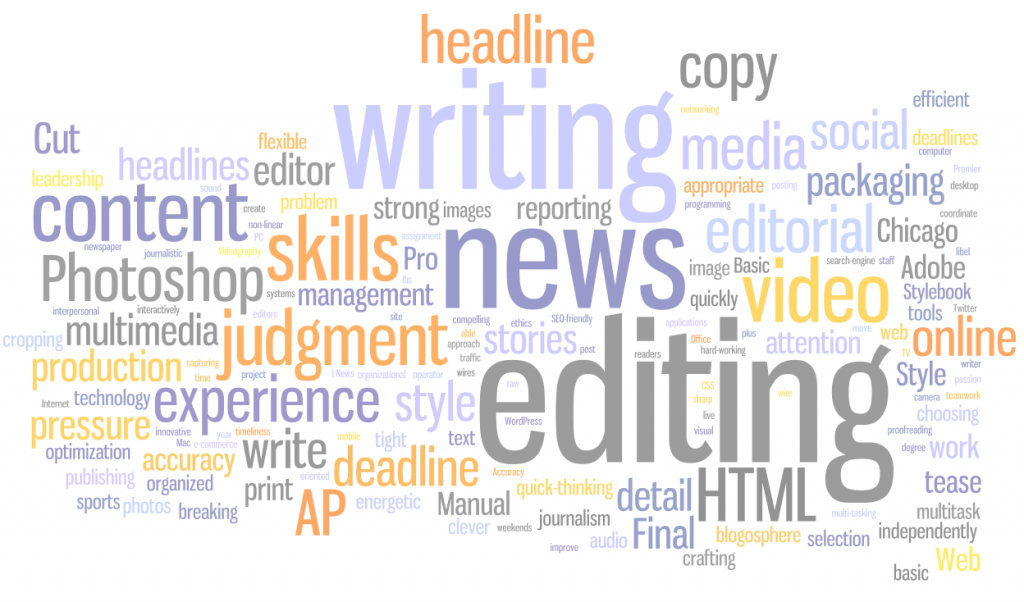
If you must know, here are the skills I collected:
HTML, Mac, PC, AP style, news judgment, copy editing, headline editing, organized, interact with online readers and newspaper staff, multitask on deadline, video and audio editing, improve site traffic trends, OAS, posting information, wire copy, photos, HTML, CSS, sports fan, Copy editing, headline writing, nights, holidays, weekends, accuracy, attention to detail, problem solving, Photoshop, deadlines, optimization, innovative editor, search engines, social networks, headline writing, Financial news editing experience, multimedia approach to Web content, video, graphics, photos, polls, social networking media, Four year college degree, TV/Web production, journalism, new media, Final Cut pro, Adobe Photoshop, Basic script and package writing skills, strong editorial judgment, strong time management skills, work independently, tight deadline, detail oriented, live and on-demand video production, think like a producer, editor, and writer, basic video editing, program production, edit raw video, headlines and descriptions, leadership, web based experience, multiple media, print headline writing and editing, grammar, spelling, punctuation, usage and style, multitasking, news judgment, accuracy, news on the Internet, news wires, coordinate assignment and development of stories, video and interactive, accuracy, timeliness, balance, comprehensiveness, multimedia, Traditional journalism skills, move beyond text to tell stories interactively, team player, design experience a plus, desktop computer applications, editorial content from television and print, accurate, collaborate with editors, write copy, create compelling headlines and captions, organize multimedia and make sound news judgments, strong news judgment, blogosphere, passion for sports, flexible, quick-thinking, energetic, efficient, and able to work independently under pressure, attention to detail, crafting clever headlines and tease copy, choosing and cropping appropriate images, packaging, editing, writing for the Web, headline writing, image selection, and content packaging skills, AP Stylebook and Chicago Manual of Style, work quickly, breaking news, deadline pressure, Basic HTML, Photoshop, online publishing tools, news judgment, blogosphere, flexible, quick-thinking, energetic, efficient, crafting clever headlines and tease copy, choosing and cropping appropriate images, packaging, editing, and writing for the Web, headline writing, image selection, and content packaging skills, AP Stylebook and Chicago Manual of Style, HTML, Photoshop, online publishing tools, technology experience and connections, IT reporting, editing experience, sharp writing, editing, write SEO-friendly content, tease text, HTML, write quickly, breaking news, technology reporting and editing, editing stories, news writing, interviewing, computers, word processing, news judgment, editorial, creative skills, journalistic ethics, libel laws, write clearly, AP writing style, TV camera operator, video editor, Adobe Premier, Final Cut Pro, news judgment, social media, Twitter, Facebook, aggressive, hard-working editor, multi-media reporting, social media, communication, organizational, multitask, multimedia production, editorial experience in print, online or broadcast, leadership, teamwork, interpersonal, under pressure, tight deadlines, problem solve, Photoshop, Final Cut Pro, WordPress, content management systems, write, produce and post content, news editorial, AP style, Accuracy, Deadline-oriented, organized, multi-tasking, I-News, HTML, Adobe Photoshop, nonlinear editing, writing skills, editorial skills, attention to detail, writing and editing online copy, project management, social media, HTML, search-engine optimization, e-commerce, web analytics, basic programming, mobile, RSS, audio podcasts, video, writing, editing, and proofreading, Chicago Manual of Style, deadline pressure, Microsoft Office, writing, capturing visual content and editing stories, Videography, non-linear editing, Final Cut Pro, AP style, deadline, Lift up to 50 lbs.

If you want to check it out, here are the postings:
http://www.journalismjobs.com/Job_Listing.cfm?JobID=1148011
http://www.journalismjobs.com/Job_Listing.cfm?JobID=1147856
http://www.journalismjobs.com/Job_Listing.cfm?JobID=1147846
http://www.journalismjobs.com/Job_Listing.cfm?JobID=1147737
http://www.journalismjobs.com/Job_Listing.cfm?JobID=1147522
http://www.journalismjobs.com/Job_Listing.cfm?JobID=1147535
http://www.journalismjobs.com/Job_Listing.cfm?JobID=1147497
http://www.journalismjobs.com/Job_Listing.cfm?JobID=1136912
http://www.journalismjobs.com/Job_Listing.cfm?JobID=1113672
http://www.journalismjobs.com/Job_Listing.cfm?JobID=1134208
http://www.journalismjobs.com/Job_Listing.cfm?JobID=1147267
http://www.journalismjobs.com/Job_Listing.cfm?JobID=1147236
http://www.journalismjobs.com/Job_Listing.cfm?JobID=1147155
http://www.journalismjobs.com/Job_Listing.cfm?JobID=1147127
http://www.journalismjobs.com/Job_Listing.cfm?JobID=1147056
http://www.journalismjobs.com/Job_Listing.cfm?JobID=1147032
http://www.journalismjobs.com/Job_Listing.cfm?JobID=1147017
http://www.journalismjobs.com/Job_Listing.cfm?JobID=1146274
http://www.journalismjobs.com/Job_Listing.cfm?JobID=1145926
http://www.journalismjobs.com/Job_Listing.cfm?JobID=1144661
http://www.journalismjobs.com/Job_Listing.cfm?JobID=1144610
http://www.journalismjobs.com/Job_Listing.cfm?JobID=1144331

As a bonus, I created a Wordle based on the titles:
Online Content Manager, Editor, Search Editor, Business/Financial News Editor, Associate Producer of Video, Health Producer, Senior Editor for News, Sports Programmer, Personal Finance Programmer, Business/Technology Web Editor, Reporter, Combat Sports Reporter, Home and Garden Article Writers, TV ‘shoot-edit’ & web videographer, News Social Media Editor, Editor, Enterprising Legal Reporter, Interactive Managing Editor, Website Content Producer, Web Content Producer, Digital-Media Director, Multi-Media Journalist

What skills do you think are the most important for Web journalists?


Categories: Journalism Tags: , ,
28 Jan

Two business card alternatives: Save the trees, embrace the geekiness

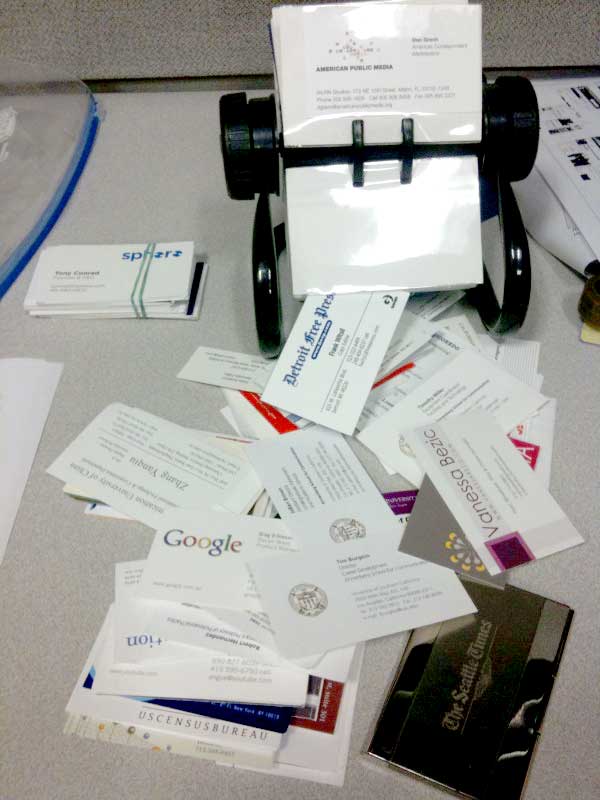
My paper contacts in my office.

A few months ago, I uploaded a photo of my trusty, old Rolodex onto Facebook.

Over the years I have met some great people, collected a ton of business cards and attempted to alphabetize them in my Rolodex.

That alphabetizing part only lasted about 20 minutes some ten years ago.

Since then, I have had piles from different conferences strategically growing on my desk, in my backpack and around my Rolodex.

So, if business cards don’t work for me, what would?

Here are two ways I’ve begun sharing my contact info. Both of these I learned from people at I’ve meet at conferences.

The first is the extremely, iPhone-geeky-awesome Bump. This was introduced to me by David Stanton (@gotoplanb), Poynter Institute and University of Florida instructor, and all around cool tech guy. We met at AEJMC and sure, it probably took longer than physically swapping business cards, using the bump was much more fun. More importantly, it gets the contact information into your phone!

Why is it called Bump? To swap info, each iPhone user first loads up the free app, establishes a connection, then does a fist bump. Okay, the fist bump is actually optional… but the gesture/motion between the two iPhones triggers the app to look for a receiver/sender and syncs up the info. [See the video]

The second is simply, simple and I can’t believe it is free. At this year’s CES, I met some great L.A. tech folks, including Lisa Borodkin (@lisaborodkin). She’s an Entertainment + new media law and policy expert that is jumping into Web journalism reporting for LAist.

I didn’t believe her, but she asked me to text her first name to get a text back with her contact info. I did it, it worked. I set mine up.

Contxts is awesome. The downside: it’s in the SMS side of your phone, not contact side. But, it’s in your phone and adding it to your contacts shouldn’t take too long.

How’s it work, exactly? Just have people text your name/code to 50500 and boom, they get your info. I got greedy, so I have two accounts: webjournalist and roberth.

Try ’em out and tell me what you think.

There are TONS of alternatives to business cards swaps, and these are just two I’ve played with. Which ones have you used? What do you recommend we try or try to avoid?

Let’s do what we can to save the trees… and embrace your inner geek.

27 Jan

Apple’s iPad matches hype, but it’s no print industry savior

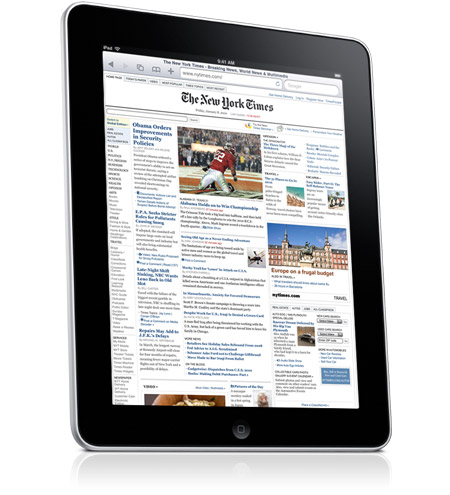
NYTimes created an iPad app that takes advantage of the new platform.

NYTimes created an iPad app that takes advantage of the new platform.

Well, it surely doesn’t have the best name, but the much anticipated, the much rumored and the much hyped iPad is finally here.

For those in the newspaper and magazine industries, the iPad has been championed as the device that will save them from bankruptcy. For those who knew of Tablets PC from years ago, this was going to be a flop.

My impression: Damn, it’s slick!

First, snap out of it… this will not save the print industry. Stop it. Who are you kidding? Content is, for the most part, the same as a Web site.

What this does do is give the content creators another distribution method to share news and information. Another opportunity to develop a way to deliver engaging content and capture the elusive revenue.

But, like the Democrats’ attempt at overhauling Health Care, the track record and innovation from our industry’s leadership is… well… lacking.

That said, let’s leave the revenue model/funding concerns for another day. Let’s take a closer look at this device and how it can really change how we cover news.

Here’s what it has:
– Incredible price
– Long battery life – allegedly
– An established OS
– WiFi enabled and upgradable to 3G – sadly through AT&T
– Assisted GPS – with 3G
– Translates existing iPhone apps and the established marketplace
– You can buy an adapter to read SD card

Here’s what’s missing:
– Camera
Adobe Flash compatible, although there is a report that this may soon change.
– Wireless charging
– Wireless syncing
– Tethering

There are some significant unknowns:
– How easy is it to type on?
– Is this a truly mobile device? Will we remember to take it with us?
– How durable is that thin screen?
– Will people want this?
– It’s not E Ink (thank goodness), but will you read books on it? Eyes be damned?

In short, it’s a bigger, stronger iPhone – minus the camera.

From my perspective, depending on the keyboard, this could be the device that really allows Mobile Journalists to be be truly mobile. It’s not the *Multimedia* Journalists’ tool yet, but at least you could potentially use this device instead of your phone or laptop to file your story. You can use the SD card reader to transmit your pics and video.

Any way you slice this, Steve Jobs and Apple have really created an impressive product and a new category that can really shake things up. This may not be our industry’s silver bullet, but it is a great opportunity for us to innovate… let’s not screw this up!

15 Jan

Tech & Tools: A collection multimedia tools

Comments off

This pages was created some time ago, displaying a collection of tools, including those pictured below. Go here for the complete list or click on the image.

Click on the image to go to the Tech & Tools page.

13 Jan

Web Journalism Roundup: Haitian earthquake coverage

The recent Haitian tragedy has generated coverage from not only the mainstream media but from all over the Web. Taking on different shapes and technologies, here’s a roundup from good friend Mark Luckie and myself. Please send us more!

:: UPDATED ::
New satellite photos show some devastating comparisons before the major quake rocked Haiti. Wired Magazine compared images: http://www.wired.com/wiredscience/2010/01/satellite-photos-of-haiti-before-and-after-the-earthquake/.

NYTimes also compared before and after images with their impressive swipe tool: http://www.nytimes.com/interactive/2010/01/14/world/20100114-haiti-imagery.html.

CNN showcased raw street cam video as the quake hit. (Credited to CBS, but I could not find it on their site.): http://www.cnn.com/video/#/video/world/2010/01/14/moment.of.haiti.quake.cbs?hpt=C2.

A collection of viewer submitted stories looking for missing love ones.

CNN’s iReport was made for a story like this. Knowing they are an international hub, they created a “Looking for loved ones in Haiti” section which is pretty compelling: http://www.ireport.com/ir-topic-stories.jspa?topicId=381628.

Geo information is one of the newest and most powerful tools we now have. The site GeoCommons “delivers visual analytics through maps.” Here’s a map of Haiti earthquake data: http://maker.geocommons.com/maps/10987.

A group called the International Network of Crisis Mappers has paired up with local officials, it seems, to try to map incidents and missing people: http://haiti.ushahidi.com/.

The LATimes has launch its GoogleMap to help cover the story as well: http://www.latimes.com/news/nation-and-world/la-fg-haiti-quake14-2010jan14-map,0,564631.htmlstory. And they also offer a Flash earthquake primer: http://www.latimes.com/news/local/la-me-quakeprimer-fl,0,410617.flash.

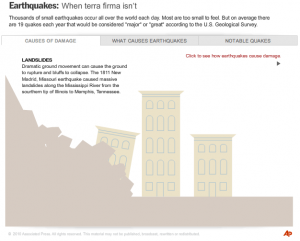
AP's earthquake Flash graphic

The Associated Press sent out one of their special Flash graphics that is available to all its members. This one was hosted on ABCNews.com: http://abcnews.go.com/International/HaitiEarthquake.

The standard tool when covering breaking news is a photo gallery. This event generated many incredibly moving images that led to several galleries, many starting with a warning. Here’s one by MSNBC: http://www.msnbc.msn.com/id/34833017/ns/news-picture_stories/. Boston.com’s Big Picture did what it does best and just let you have it without a warning: http://www.boston.com/bigpicture/2010/01/earthquake_in_haiti.html.

The NYTimes took a slightly different approach to photography with their tool that allowed you to really study an image: http://www.nytimes.com/interactive/2010/01/13/world/20100113-haiti-close-ups.html.

PicFrong is a real time photo search. Here are the Haiti results. Be warned, there are some graphic images flowing in: http://picfog.com/search/Haiti.

BBC offered an aerial view of the scene with its simple, raw video: http://news.bbc.co.uk/2/hi/americas/8458266.stm.

Live radio from Haiti: http://radiostationworld.com/locations/Haiti/radio_websites.asp.

This piece from the Sydney Morning Herald has some intense video, photos and more as it looks at “how the net revealed Haiti horror”: http://www.smh.com.au/technology/technology-news/wired-for-disaster-how-net-revealed-haiti-horror-20100113-m6cz.html.

Twitter has been an incredible source. Here’s the latest with the hashtag #haiti: http://search.twitter.com/search?q=%23haiti But you can also get more detailed with tweets from the ground. Here is a search looking for tweets in a 50-mile radius to Port-au-Prince: http://bit.ly/8pFVuW.

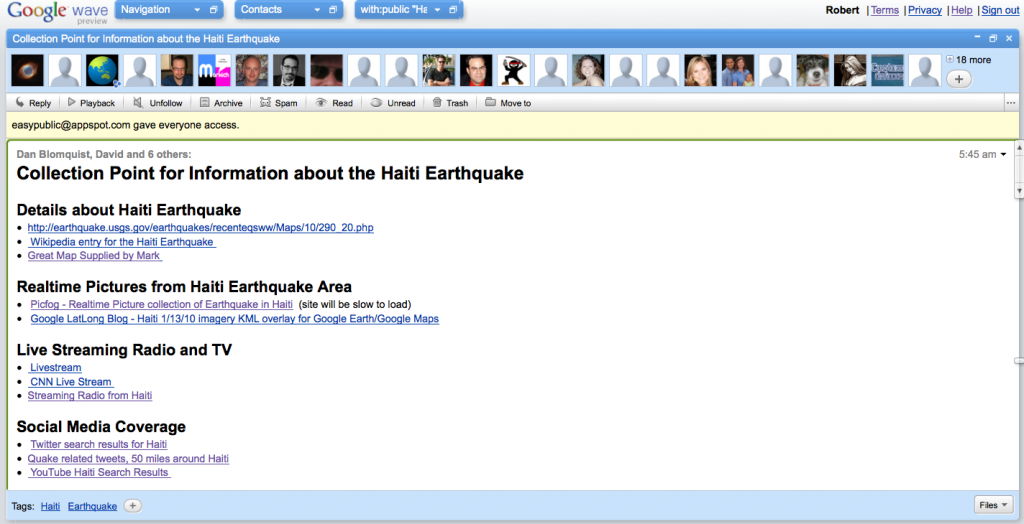
In another GoogleWave experiment, someone launched a public wave to aggregate news and information from mainstream, indie, and live sources: http://dhp.me/haitiwave.

This public Google Wave has a collection of links submitted by anyone with a Wave account.

Please send in more examples!

11 Dec

Gaming changing tool: UStream iPhone App

Comments off

With all the new technology that continues to come out, it actually is hard for me to get impressed by something. I can think of only a handful of times that my jaw dropped.

This may be one of those times.

For more than a year now, I and some seattletimes.com colleagues had been experimenting with livestream. It’s been a virtual arms race to see who would own and lead that technology. From Justin.tv to livestream.com (formerly Mogulus) to Kyte.tv to UStream.tv, each had very cool features and some significant weaknesses. (When I get a chance, I’ll post my experiences with each and a review of them.)

These free live streaming apps allowed journalists to do live video from just about anywhere, taking on TV’s ownership of live shots. All you needed was a camera, laptop and a strong, reliable Internet connection.

At ST.com we tried a variety of experiments, some more successful than others… but we tried. We knew it was just a matter of time before the technology would catch up to our ideas. While not perfect yet, technology has been making some significant strides… and yesterday was a big step.

In addition to live streaming from your laptop, there was an even smaller arms race from a few folks wanting to stream from your cell phone.

Qik was one of the first… but you had to have a special phone. When the iPhone came out, Qik would only work if you had a jail-broken iPhone. Then they finally had an approved app, but live streaming was not a feature.

Skype would work on one-to-one calls, but only on WiFi, not 3G.

No one had cracked the nut to offer streaming from your phone, broadcasting live to the world. Well, no one, until UStream’s new iPhone that was released earlier this week.

Let me just say it: This is a journalism game changer. Professional, citizen, whatever! You can now cover breaking news from your phone to your homepage to the world. Awesome!

I downloaded the free app and took it for a test drive. As with all technology, there are some strengths, there are some weaknesses… but, for the most part, it worked!

Here are some videos I did the morning the app was released:

STRENGTHS: WEAKNESSES:
> It works on both 3G and WiFi. > UM, you’re depending on the AT&T network. Enough said.
> UStream’s video-related chatrooms is displayed on your iPhone screen. > The quality of the content coming from those chatters is still, well, low.
> It gets published and promoted on Twitter, Facebook, YouTube and your channel. > When you are testing it out, you may swamp your friends with repeat “Check out this video” as you practice.
> You can offer polls during your stream. > I don’t know if you can craft the question, especially when live streaming.
> Visual quality is as good as the iPhone’s camera. > Visual quality is as good as the iPhone’s camera. I have shaky hands, which means you see shaky video.
> The audio quality is decent for what it is. I used the mic/ear buds, but found that actually hurt the quality. > No real external mic jack — because it’s a PHONE, not a camera!
> It’s free! > People see a lower third ad when viewing your video. But it’s freakin’ free to use!

Overall, if you have an iPhone, you HAVE TO GET THIS APP! (That’s right, all in caps.) Get the UStream app and get to work!