Archive

Archive for the ‘Journalism’ Category
15 Dec

We’ll draw the lines we will not cross

Comments off

Nieman Lab. Predictions for Journalism, 2025
https://www.niemanlab.org/2024/12/well-draw-the-lines-we-will-not-cross/

In the past, I’ve made predictions about emerging tech or, like last year, predicted the painful shortcomings of our industry leaders. (I’m sorry that one keeps coming true.)

This year, I could predict that Bluesky will successfully emerge as the new social media platform of choice for news/media friends and junkies. (Follow me here.)

Or I could predict, rather reliably, that an AI “news” product will fail miserably and continue to reveal the tech’s inability to match the (grifter) hype. (I fully believe in the tech, just not the vendors who are selling it to uninformed leaders hungry for an easy answer to address their ongoing shortcomings.)

Or that an owner of a news org will choose to appease the president-elect in order to advance their personal financial self-interest. Or, hell, all three at once.

But this year, I predict that you — yes, you — will stand up, speak up, and do the right thing for the communities we aim to serve, including many who either are or will be under attack by the incoming administration.

I predict that you — possibly in a small conference room with just a handful of colleagues, or in a one-on-one meeting with your boss, or on a stage in front of a large audience, or most likely through an email — will realize that this is the moment you can’t stay silent and must finally speak up.

Trans people are human beings. Immigrants are human beings. Palestinians are human beings.

Women’s rights are human rights. A lie is a lie, not an alternative fact. Racism is racism, not “racially tinged.”

Not all stories have two sides. And some that do do not have equal weighted sides. There are going to be so many of these big moments, so be prepared.

Before the start of the new year, I want you to write down and remember: What are your values? What do you stand for now…before it gets any tougher? Are you willing to speak up? Are you willing to quit your job? Are you willing to put your safety on the line for those values?

I don’t pretend to know where each of us will draw the line — but I believe that we each have a line that we will not cross and where we can no longer stay silent.

And while many of us have the luxury of time to contemplate where our line may or may not be, many, many others do not. They have been harassed. They have been attacked. They have been killed. This is not an exercise of “what ifs” — it’s a reality of “what now.”

And I have faith that you — yes, you — will stand up to meet the moment to give a full-throated answer to whatever tough question this new reality will bring you.

The time has come to speak up for what you think is right. Don’t let our communities — especially the vulnerable ones that are current being attacked and dehumanized — down. Don’t let me down. More importantly, don’t let yourself down.

15 Oct

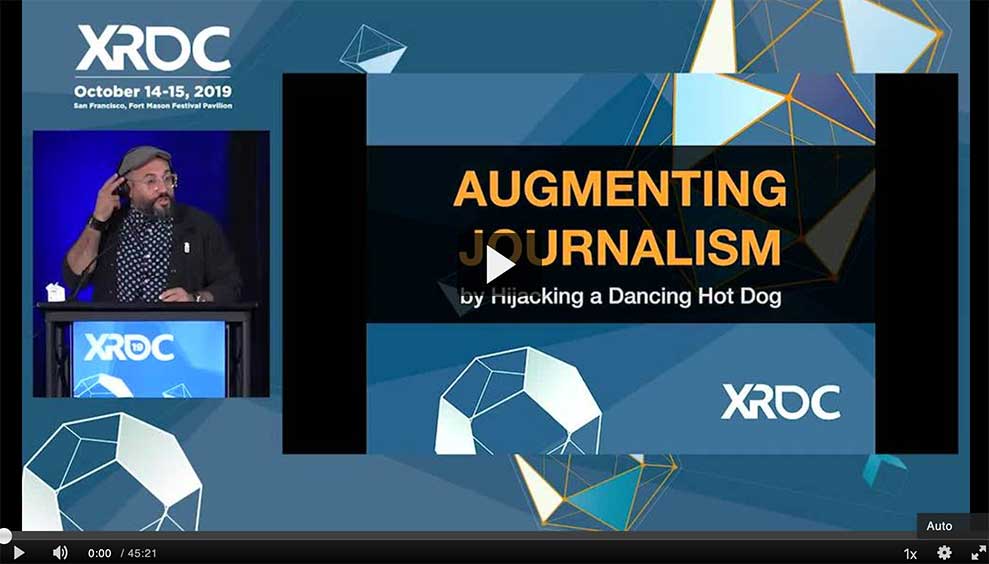
XRDC: Augmenting Journalism by Hijacking a Dancing Hot Dog

Comments off

For the most part, AR is making headway through face filters and ephemeral content like Snapchat’s Dancing Hot Dog. But how might this technology be used for non-fiction/journalism stories around homelessness, immigration and other serious topics? This panel I organized brought innovative journalists from diverse media organizations who are pioneering ways to incorporate this technology into their type of storytelling.

The panelists were:

  • Marcelle Hopkins (Co-Director of Immersive Journalism, The New York Times)
  • Elite Truong (Deputy Editor, Strategic Initiatives, The Washington Post)
  • Chaitanya Shah (Developer, Emblematic Group)
  • Moderated by Robert Hernandez (Digital Professor/Founder, USC Annenberg/JOVRNALISM)

    Watch the video here:

    Link: https://www.gdcvault.com/play/1026567/Augmenting-Journalism-by-Hijacking-a

    22 Jun

    5 ways to have immediate impact on your industry

    Comments off

    NOTE: I quickly wrote up this post right before a flight and haven’t really copyedited yet.

    Diversity and inclusion is a challenge that often feels like an overwhelming problem that we, as individuals, don’t seem to have the influence or resources to tackle.

    We commonly say “I’m not hiring” or “I don’t have money to make an impact” and all these may be true.

    But, as SXSW opens PanelPicker, CES calls for speakers, and conferences like NAHJ18 and ONA18 are quickly approaching, I wanted to share some practical things YOU can do to make a difference.

    1. Pitch a session! There is a difference between those on stage and those sitting in the audience, and often it’s not the level of expertise. It’s about who took the time to fill out a form and who didn’t. You are qualified to be on a panel about something you are genuinely passionate about. Invest some time to fill out a form increase the likelihood of unlocking some financial support to attend the industry conference, ranging from registration to travel and lodging.
    2. But don’t make your session about diversity. I have been on countless of diversity focused panels, typically presented to a nearly empty room. My most recent one was at SXSW and that will be my last “diversity” panel. My new approach, and one that I recommend to you, is to be on the leading topics of our industry. I – like many of women and people of color – are qualified to be on panels besides the topic of diversity. And being on non-diversity related panel helps normalize that women and people of color are naturally among the experts about the topic. And, let’s be real, more people will attend a non-diversity related panel.
    3. Recruit a reflect panel. If your session was selected, make sure your panelists are representative of our diverse community. Do you best to include panelists from diverse backgrounds to debunk any stereotypes. Don’t only think about gender, ethnicity and sexual orientation, but think geography, size of their organization, skill/experience level, etc. The panelists should not look all like you or share your background.
    4. Panelist rather than organizer. If you aren’t the organizer, you still have some influence about who is participating in the session. Ask how diverse the panelist group is and offer to recruit someone qualified that also looks different from the rest of the panel. Often you are help the organizer out. If it is all male, I really encourage you to give up your spot and recruit a replacement that reflects diversity. This simple and powerful step really amplifies others.
    5. Give away your registration. If you are employed, I highly encourage you to ask your employer to pay for your conference related expenses. And, if the conference is offering to cover your expenses STILL HAVE YOUR EMPLOYER pay. And giveaway your conference – and possibly the other resources – to someone else. Look, they were going to pay anyway and they were going to comp you anyway… why not pay it forward to someone who needs help. Everybody wins.

    I have done each of these – multiple times for years. I have no money. I have a kid to fund. I am not hiring anyone. But these simple ways can have large impact.

    If you truly care about inclusion and diversity in our industry – or any other industry – try a few of these tips to help make a real impact.

    Please let me know if you have other tips and if you have done these too. We have more influence than we think.

    27 Feb

    A 360/VR audio tour of Seattle’s Olympic Sculpture Park

    Comments off

    This 360/VR audio tour was made with Story Spheres and audio I produced for the launch of the sculpture park in 2007. I recorded then Art Critic Sheila Farr about individual art pieces, as well as the lead designers for the park.

    Get the immersive experience via your phone (and Google Cardboard) by going to this URL: https://www.storyspheres.com/scene/3BFb9RY6

    You can see the old (kinda broken) project here: http://o.seattletimes.nwsource.com/html/sculpturepark/

    19 Feb

    Sixteen apps for 2016

    Comments off

    This piece was written for SPJ’s magazine, Quill. You can read it here: http://www.spj.org/quill_issue.asp?ref=2245

    One of the first workshops I gave as a new professor was to introduce journalists to a few tools and applications I found on the web that they could use when producing a multimedia story.

    Six and a half years later, that small workshop has morphed into a side project that has a collection of more than 100 types of tech and tools to help journalists be more digital.

    The collection can be overwhelming.

    But, as journalists adapting and working in his quick-moving digital era, we need to add some of these seemingly countless tools to our journalism toolbox.

    As we launch head first into 2016 and beyond, here are some tech, tools and apps every journalist should be aware of. This is just a small selection from the growing list of apps. Make sure you share your recommendations, too. (Ping me on Twitter: @webjournalist.)

    NOTE: As we know, technology moves fast. By the time this piece gets published, there may be a new thingy that we need to add, or an old thingy that needs to be removed. The real goal here is to be aware of the diverse tools and be open to how we can each integrate many of them into our daily journalism.

    Let’s start with the basic set of mobile apps all journalists should have on their smartphones. I am talking about the pillars of journalism: writing, photography, audio and video.

    Read the list here: http://www.spj.org/quill_issue.asp?ref=2245

    19 Dec

    My Nieman Lab prediction: 2016 is VR’s time

    Comments off

    Screen Shot 2016-02-27 at 6.30.11 PM

    Role up your sleeves, journo industry, because you need to start preparing to lead the next disruption. When it actually hits is nearly irrelevant, because there’s no doubt it will hit.”

    You can read the piece here: http://www.niemanlab.org/2015/12/the-year-virtual-reality-becomes-reality/

    06 Nov

    NYT VR: It’s just the beginning of a long road

    Comments off

    IMG_0230

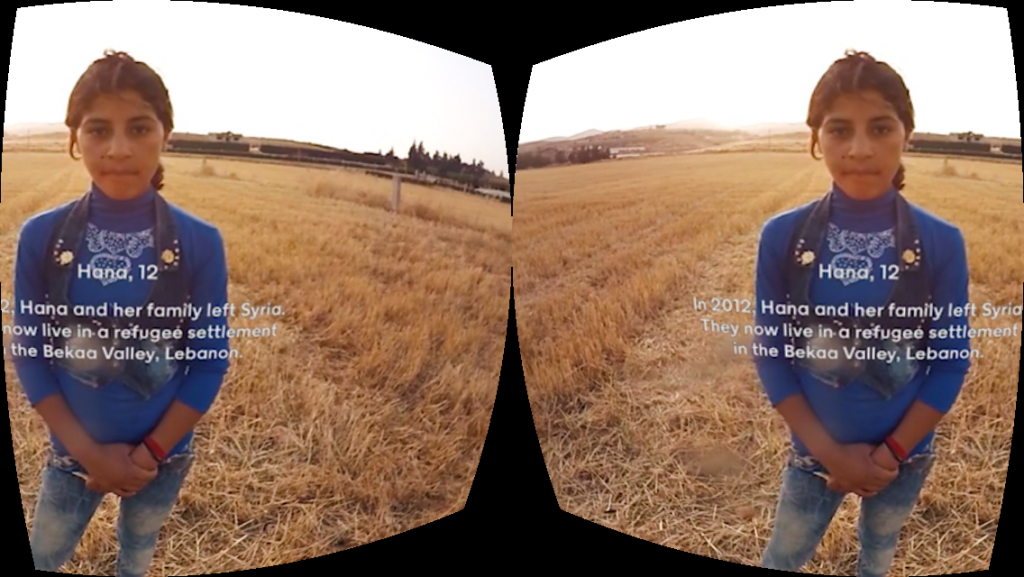
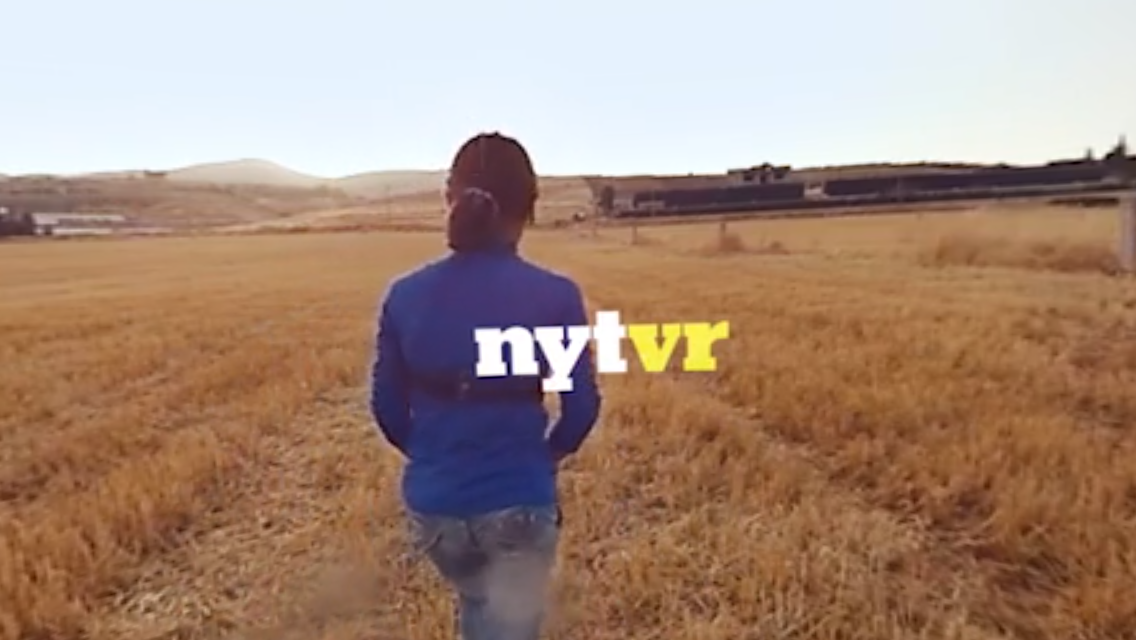
    I watched NYT/VRSE’s VR mini documentary called The Displaced, through the newly launched NYT VR app and it is clearly a sign of things to come.

    Here are some thoughts after I watched the piece.

    First, like other VR apps, the app itself took seconds to download, but the actual VR content took more time. The Displaced was 329MBs and took a few minutes to download. How long? I don’t know, I set it to download and worked on other things.

    Whether we like it or not, this is the current state of VR… streaming is still clunky, but, of course, it’s just a matter of time before the tech catches up.

    Now the piece itself.

    It was gorgeous.

    There are some truly beautiful shots they got and could only capture through a 360 rig.

    They displayed creativity by having diverse shots, ranging from static with a tripod to mounted on a bike to handheld by a kid run after another.

    You can tell by the rig's shadow, it's not the GoPro setup.

    You can tell by the rig’s shadow, it’s not the GoPro setup.

    The stitching, which is one of the major challenges in video VR, was pretty impressive and, based on the shadows the rig left, this was captured and stitched through something more advanced that the “simple” 6-camera, GoPro rig. Perhaps a Jaunt VR or Nokia’s Ozo setup.

    The audio was the “voice of god” style and was not 360, but it was still powerful to hear the children in their our voices and languages, telling their own stories.

    Due to the languages, the piece relied on subtitles.

    And, while they cleverly placed the subtitles around three locations, the text was still hard to read, at least via Google Cardboard.

    Bonus: You can watch this piece holding your phone vertically and but’s a great experience. (Whether you like it or not, vertical video is winning!)

    Now, the bad news.

    Outside of the high-level understanding of the story – three displaced kids – I don’t know what they really said. I couldn’t quote it back to you.

    This is one of those it’s-beautiful-like-Snow-Fall-but-I-don’t-remember-the-actual-story situation, which VR is going to face as it starts out.

    Most VR offers the flash of new and cool through tech rather than substance of story, but this piece really tried to deliver the story. It has incredible shots and visually takes advantage of each 360 degree.

    But it’s not a powerful piece like, say, Perspectives I: The Party.

    The real test is whether or not people download the next set of stories and continue to use the app – with or without Cardboard. That’s a high bar that content I can’t remember may not make it over. It’s a high bar that we all have to overcome if we want this to truly take off.

    I am excited for what’s to come and – from I hear through the VR community – you should be too.
    IMG_0236

    I spy the production crew (the only show you really see them).

    22 Oct

    You don’t need to be the NYTimes to do VR (posted on Medium)

    Comments off

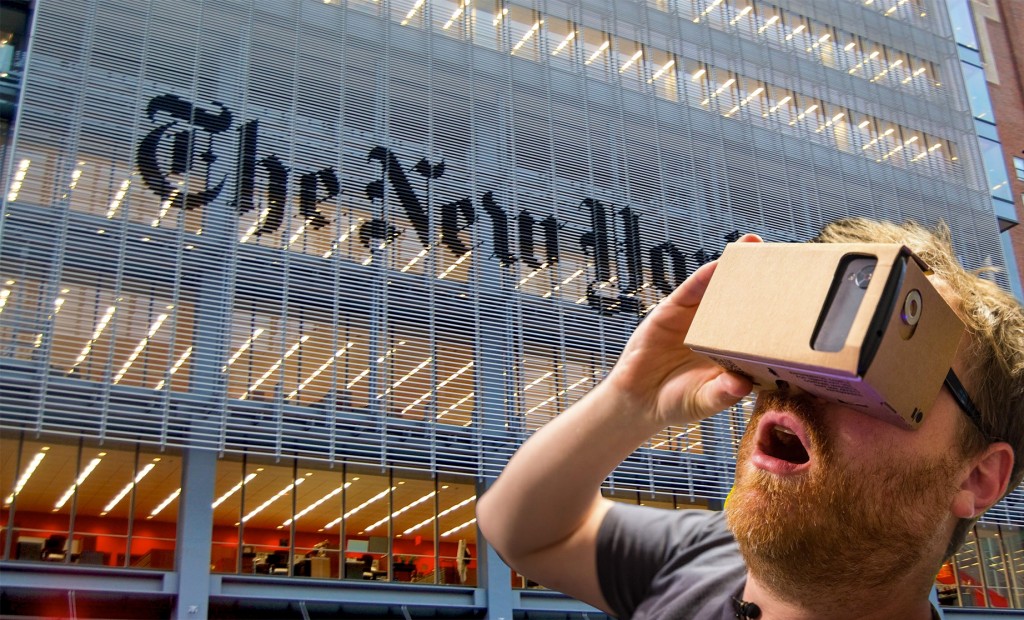
    I wrote this piece reacting to the news that The New York Times and Google were partnering up to do a major VR push. Got a lot of social shared and recommendations via Medium.

    nytimes-vr-google-cardboard

    Yay! Here comes everybody!

    It’s great to see the rush of people coming to explore the emerging tech of virtual reality. Yes, it appears the overly-hyped promise that under delivered for several decades has finally become a legitimate reality.

    All thanks to a former journalism student turned billionaire and this smart lady.

    I’ve been exploring different forms of VR dating back to my college days when I was fascinated by Apple QuickTime VT Studio, but I am no pioneer. I have been more into Augmented Reality (I still think it is the most promising future) since I became a professor at USC Annenberg some six years ago.

    But after attending a local VR conference about a year ago, I knew this was going to be huge.

    So, I created a course with the aim of exploring what the hell VR experiences could be in journalism.

    Read more here: https://medium.com/@webjournalist/you-don-t-need-to-be-the-nytimes-to-do-vr-be4efb00ff74

    09 Oct

    My teaching style inspired another professor

    Comments off

    When I started the semester last fall, I put my faith in gnomes and underpants.”

    The opening line from a MediaShift post written by Prof. Stacy Forster.

    It was an analogy I’d heard over the summer from the University of Southern California’s Robert Hernandez at the Poynter Institute’s Teachapalooza seminar. Hernandez said he approached student projects like the gnomes in a South Park episode approached a business plan.”

    I’m honored that my style of teaching inspired another professor… and their project sounds pretty bad ass!

    Go read her piece! http://mediashift.org/2015/10/how-wisconsin-students-took-the-lead-on-water-quality-projects/

    24 Aug

    Hurricane Katrina and VR Journalism

    Comments off

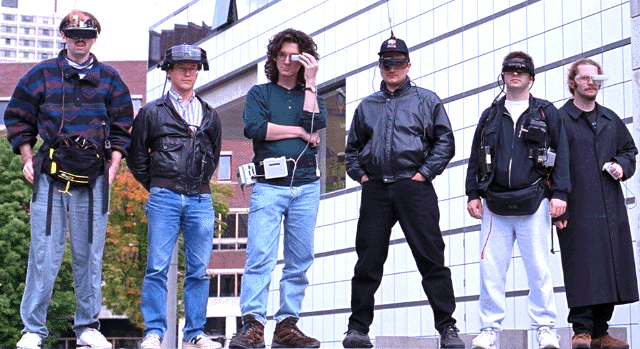
    Tech has always been dorky. Long before Google Glass, nerds were looking like geeks in the name of innovation.

    I’ve done my share of looking foolish, but I do it in the name of journalism.

    This week marks the start of my latest innovative, hackathon style course… this year it’s Virtual Reality Journalism. (Last year it was Glass Journalism and Augmented Reality Journalism before that.)

    This week also marks the 10-year anniversary of Hurricane Katrina.

    There are a lot of things to remember and reflect on, especially in regards to journalism. I remember the amazing work done by the Times-Picayune/NOLA.com, that literally saved lives.

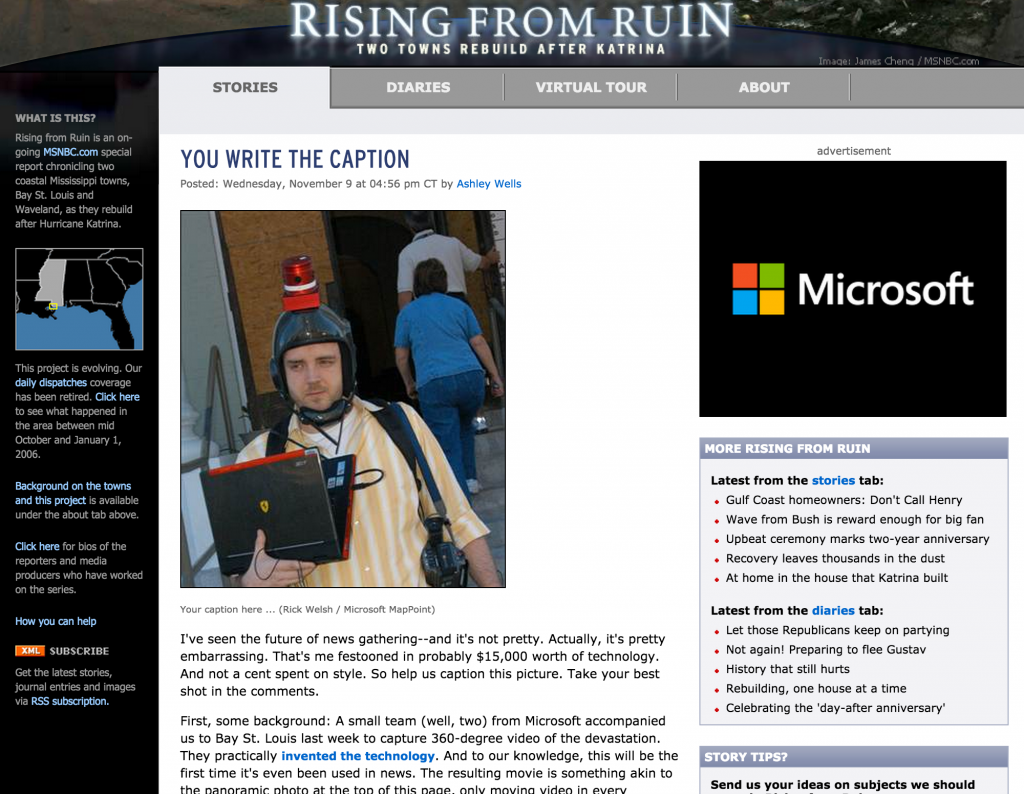
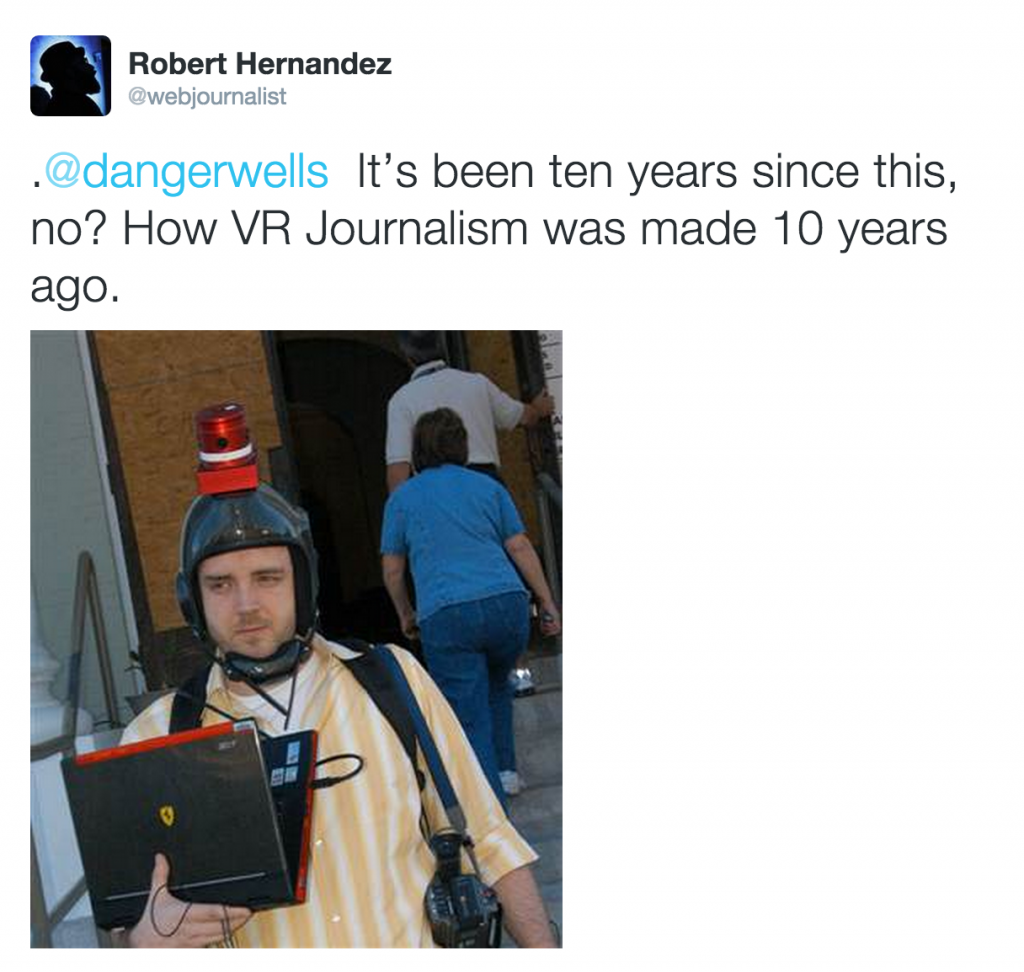
    But, perhaps because I am a dork, I mostly remember this photo:

    VR is something that I’ve always kept my eye on. My experience began with Apple’s QuickTime VR Studio and I managed to work that tech (paired with ambient sound) into some multimedia coverage I did at the Seattle Times.

    Those links are pretty much dead, but the Bering Sea and the Olympic Sculpture Park were two projects I did this with.

    That said, the first time I saw 360-degree video in news was ten years ago when MSNBC’s special Katrina project Rising from Ruin.

    I saw the video and was blown away (video no longer works… they killed it, I think, for their year anniversary).

    But they kept this page… a page I looked at in awe.

    Direct link: http://risingfromruin.msnbc.com/2005/11/you_write_the_c.html

    It never occurred to me to reach out to the guy in the photo (Ashley Wells / @DangerWells), but I did today:

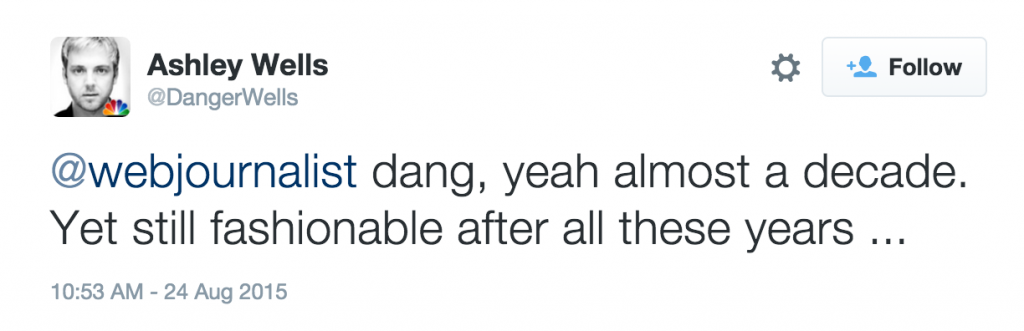
    He replied:

    While impromptu and we both don’t have the time, I asked him for an interview. I’ll keep you posted.