Archive

Author Archive
24 Sep

Getting on WBUR’s On Point

Comments off

[Posting this late]

During ONA11, I was a guest on WBUR’s On Point show along with Derrick Ashong and Mandy Jenkins.

This was my first time on live air on a national show… um, and I had a cough.

The topic was Crowdsourcing And The Future Of News. Awkwardly, here it is:

[audio:http://audio.wbur.org/storage/2011/09/onpoint_0923_2.mp3]
21 Sep

Talk Journalism with Me

Comments off

I’ve written about experimenting with Google+ Hangouts before, and finally did a project inspired by Jon Favreau‘s Dinner for Five on IFC and Talking Funny on HBO: http://talk.journalismwith.me.

@talkJournalism or #tjwm hopes to be an entertaining and insightful look into the minds of some of the country’s leading journalism thinkers/doers. The informal ‘show’ is held through a Google+ Hangout and broadcasted out using UStream.

Here’s the first episode… you will notice it’s a work in progress… it did not pick up my audio for some reason.

There *will* be another episode. Trying to align the schedules of the next panel.

Please, feel free to send me feedback. Email: talk [at] journalismwith.me or tweet us by using the #tjwm hashtag.

09 Sep

Internet Evolution interview

Comments off

Posting this late, and reset publishing date

I had the honor and privilege of getting interviewed by Internet Evolution Radio.

Listen to internet radio with IE Radio on Blog Talk Radio
02 Sep

NiemanLab’s Journo Ipsum generator: I love it and cringe at the same time

Comments off

Inspired by the Lorum ipsum, which is a random collection of Latin words often used by designers as placeholder text, Nieman Lab created the Journo Ipsum generator.

In a few paragraphs, you get randomly selected journo-buzzwords mashed up with every refresh/page load. Thanks to the randomizer, you get things like:

hyperhyperlocal plagiarism trolls TBD 5%”

Patch stupid commenters”

Jeff Jarvis prostate do what you do best”

election-night hologram media bias”

the medium is the message if the news is that important”

Aron Pilhofer Android”

if the news is that important, it’ll find me dead trees”

layoffs put the paper to bed”


It’s useful for dummy text, but also as a good lesson on how taking words out of context and randomly mashing them together is unintentionally hilarious.

While I love it, is a generator potentially a bad idea?

My gut tells me, this was a good idea on paper… but not such a good idea in practice… especially because it’s connected to journalism.

These are real people, companies and brands that are being randomly paired with words they most likely want to avoid.

I guess I’m sounding like a wet blanket… I know. But there’s a reason why we use Lorum ipsum: It’s to avoid awkward phrasing and taking random words out of context!

If it were me, I’d unplug the word generator/randomizer portion and just display a dozen or so paragraphs of Journo Ipsum text … I’d even edit some awkward ones out. You’ll still offer the awesomeness of the concept, without having the, for the lack of a better word, liability.

But hey… that’s just me. What do you think?

Also, join the unintentional hilarity of the randomizer by tweeting out your finds, using the #JournoIpsum hashtag!

Well, what I can say for sure is that I’m glad I’m not a big enough name to be in that randomly mashed up mix!

03 Aug

What’s your role in correcting a retweeted hoax?

It happens to all of us, and last week it happened to me.

I got punked… by a hoax.

That study that claimed IE6 users have a lower IQ, as much as we may still feel like it’s true, was a fake.

I’ve been punked by hoaxes in the past, I’m sure, but the difference with this one is that I retweeted it and helped spread the misinformation. And, in turn, my tweet was retweeted a half dozen times.

Now, I didn’t know it was a hoax at the time. I have to admit, though, I immediately bought into it. Old browsers are hated by Web Developers. But when I shared it I was thinking it was “proof” rather than trying to willing lie to people.

In other words, I don’t think I committed a journalistic sin because I didn’t know it was fake at the time. Retweeting a rumor and treating it as fact, that’s a journalism sin… this was more a case of journalistic laziness, because in my heart “I knew it to be true.”

Typically, I read the links before I share them with others – not endorsements, per say, but informed sharing. In this case, I didn’t even question it and re-shared. (NOTE: I still believe there is something wrong with you if you are using IE6.)

Tim Carmody, who wrote the piece exposing the hoax for Wired, said it perfectly:
http://twitter.com/#!/tcarmody/status/98763883157794817

While I didn’t commit a journalism sin, I did, knowing or not, participate in spreading this hoax. So, what is my responsibility now?

I went straight to the correction expert and asked Craig Silverman, of Regret the Error, for advice. His response:
http://twitter.com/#!/CraigSilverman/status/98765056753405952

My response:
http://twitter.com/#!/webjournalist/status/98765505191608321

While not a sin, I still felt dirty. So much so, that I also posted a correction on Google+ and wrote this piece.

I’m happy to report, moments after I asked those who retweeted me to spread the corrected info, nearly all did.

What are your thoughts? How would you have corrected this “error?” Do you consider it an error?

24 Jul

How to live broadcast your Google+ Hangout

The moment I played with the Google+ Hangout function I, like many others, immediately had a ton of ideas: communal movie-watching experience, a new form of Web chat, a vodcast and more.

The first question, though, was how do you record a hangout to make a simple, informal vodcast? That was answered right away. (While not ideal, the answer is screen capture software, like Camtasia or screencast-o-matic.com.)

The next immediate question was, why stop there… while there is a ten-person limit in a Hangout, how can I broadcast this and make it a live talk show?

Today, I found the answer!

Some background: I’ve been experimenting with livestreaming at locations for a few years. At Seattletimes.com we experimented with a few setups that led to live shots from bars, outside Safeco Field and an MST3k-style commentary of a governor’s debate.

Oh the challenges we faced… but the setup has been pretty much perfected by the crew since I’ve left, but I recall the hacker tools like the “Wok-Fi.”

Justin.tv, Qik, UStream and Livestream have been the key players exploring the live streaming space, each one releasing something new and advancing the technology.

I flipped when UStream released their mobile app that allowed streaming directly from your phone over the 3G network. There are more apps that offer this now, including Twitcasting.

But today’s tech development goes to Livestream.com (formerly Mogulus) that has been owning the desktop/laptop broadcasting space. They have a downloadable application called Procaster.

The piece of software has a simple interface and is loaded with a ton of features, including the ability to broadcast your desktop. What’s also great is that you can zoom in/out to frame your shot, which makes it the ideal Google+ Hangout broadcasting tool.

Here is the video of my test with Kate Gardiner earlier today:

The first minutes of the video are of me setting everything up, but jump 7:30 minutes in to see the start of the finished product. The main need to tweak is to amplify your Hangout colleagues’ audio, but that’s an easy fix.

All you need is a free livestream account, a Web cam, strong audio speakers and people to join you in a Hangout.

Let me know how your experiments go!

18 Jul

Meme and me: Barack, Hillary and the Women’s World Cup Finals

So, there really is no need to write this… but in the back of my head… there’s a tinge of worry.

Today, after reading some comments on Google+ about expecting the Internet to merge this historic photo of the deadly Osama mission and this just-released photo of the first family watching the Women’s World Cup Finals, I couldn’t help myself and mashed together within 10 minutes.

No harm was done… it’s just another obvious Internet meme. But I thought… perhaps over thought… what if some jackass attacks me and says this threatens my journalistic credibility. What if they say that if I “fabricated” this, could I have lied elsewhere?

It’s unreasonable, no? Actually… not really.

It seems like people are often looking for ways to undermine someone’s credibility. Taking quotes out of context, re-editing video, or Photoshoping an image is not uncommon.

But there is a significant difference.

One is to lie and the other… is just Internet humor. Perhaps no different from adding a poorly written caption atop a cute cat photo.

But still… while I shared it on Google+ — and fully knowing that by posting it online it would be shared – it felt weird to see someone share it. I got worried.

What if…

In journalism, it takes years and years of hard work to build up your credibility… and sometimes one mistake to wipe it all away.

That’s the time we live in at the moment. Not just for journalists, but newsmakers and civilians as well.

Maybe that’s why I am writing this… an attempt to say THIS WAS AN INTERNET JOKE, NOT JOURNALISM.

And that’s cool, right? RIGHT?

Tell me it’s cool and that I’m over thinking this.

P.S. The Internet gets it… someone just added Sad Keanu to the photo!

12 Jul

Google+ Clip Club

Well, here’s an idea… let’s have a ‘hangout’ on G+ and watch films together that are on YouTube.

There are plenty to choose from… In the past I wrote about seeing the classic journalism film Deadline, U.S.A., which sadly has been removed. But there are many others to watch.

Maybe it’s a clip showcase… maybe it’s reviewing our work… maybe it’s a meme off, in the but-have-you-seen-this style? Maybe it’s a version of Mystery Science Theater 3000.

Anyone interested? Send me a note!

And, if you have an idea for a film/clip, submit it here!

Thanks for trying this out with me!

Robert

27 Jun

What if we are part of the voiceless community?

NOTE: Republished on Online Journalism Review: http://www.ojr.org/ojr/people/webjournalist/201106/1987/

I hate hypocrites… especially when they’re journalists.

I’ve been a bit disappointed with how some journalists have been writing about Jose Antonio Vargas‘ recent announcement that he is an undocumented immigrant. Many are questioning Vargas’ journalistic credibility because he had to hide his immigration status.

Jose Antonio VargasAs if journalists – including columnists and editors – have never lied before or broken any laws. (Just think about your college years.)

Like the communities we cover, newsrooms are filled with sinners and saints… perfectly flawed human beings.

But lies have different degrees, don’t they?

It wasn’t long ago that people had to hide, or lie about, being gay. They had to conceal a part of their true identities to avoid discrimination or to get a job, including one as a reporter.

While they felt forced to hide a part of themselves, something tells me they still made strong journalists and did not lie in their reporting.

If I recall correctly, when the gay marriage issue erupted in San Francisco, The Chronicle pulled a gay photographer off the story because editors assumed a conflict of interest. What Chronicle editors failed to note is that straight people also have opinions about gay marriage that may also pose a conflict of interest.

The bottom line is, as far as I know, Vargas never lied in his stories. And just because he had to hide about being part of a certain community, it doesn’t automatically nullify his journalistic credibility or achievements.

Being a part of a community does not disqualify him as a journalist.

Just like Diane Sawyer, for example, isn’t disqualified as a journalist because she worked in Republican Party politics before, during and after President Nixon’s administration and subsequent resignation. Same as George Stephanopoulos isn’t disqualified after working for President Clinton’s administration.

They are just two of many examples.

What has bothered me the most, really, is how journalists are treating Vargas as “other” … as if his reality is not a common one. As if undocumented immigrants, or illegal aliens or whatever label you use, aren’t part of our communities.

We are all made up of different communities, and these often are the same communities we attempt to cover through our journalism. Some communities we praise, others we tolerate and others go unacknowledged.

I, like many others, believe that a diverse newsroom – comprised of different communities – makes for stronger, more relevant journalism. But the sad reality is that not all communities are seen as equal – or as newsworthy.

Our job is to give voice to the voiceless… but what happens if we are part of the voiceless community?

That’s the position Vargas found himself in. And he, like others from different communities before him, decided to come out and remind people the “other” is really a part of “us.”

About a year ago, I actually wrote a post about this topic, but under advisement from my closest editor I deleted it.

The post was inspired by Harvey Milk‘s powerful message: “You must come out” to give a real face to a community that is under attack. This was around the time of Arizona’s SB1070 bill.

My editor thought my post could be taken out of context and hurt my career.

I don’t know how these words will be taken… and quite frankly, I’ve debated whether or not I should ever publish them… but I hope my editor is not right.

In light of Vargas’ story – one that took more courage to share than my story – I feel that I am obligated to share my experience.

Allow me, however, to frame the reason why I am sharing my story now:

  • I’m not asking for any political action. (Don’t call me an activist.)
  • I’m not trying to ride Vargas’ coattails. (Don’t call me a poser.)

I’m writing this because as journalists we can’t afford to forget that we are part of the “other” … that good journalism is truly inclusive.

I, like everyone else, am part of multiple communities: I am a father, a husband, a renter (former homeowner), college graduate, an educator, a Roman Catholic (but I often disagree with the church) and the son of immigrants from El Salvador.

While my mother entered the country by plane with the right papers, my father entered by crossing the border illegally in the 70s.

He quickly became a U.S. citizen.

But let’s be honest here, the act of an immigrant crossing the border without the right papers in pursuit of a better life often overshadows their accomplishments as legal citizens.

To clarify, I was born a U.S. citizen. But all my success as a person and as a journalist, I owe to my immigrant parents.

My father, like millions of other immigrants, reflects the story of America – whether we want to admit it or not. Coming to this land (by any means necessary) with nothing, working [expletive] hard and making a better life for himself and his family.

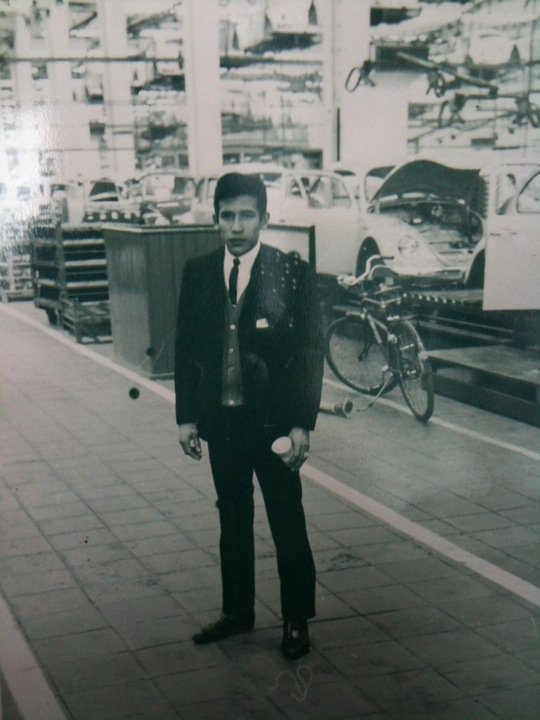
For the record, my father graduated at the top of his high school class in El Salvador, which earned him a scholarship to Germany. He worked there, but giving into the request from my mother’s family, he moved to the United States after marrying her.

My father ran several small businesses and was a homeowner for more than 40 years. He lost them in the bad economy, but had relaunched his auto repair shop early last year. He passed away in November and the outpouring of support from the local community was a true testament to his accomplishments. That man helped so many people… I had no idea.

My mother struggled and worked hard in her own immigrant story. She made a small living by cleaning houses and other service jobs, including working at the food court of Cal State University, Northridge. She joined my father as an entrepreneur until they separated.

I can tell you more about their story, but let me just say this: “Their” story is part of “my” story. And “my story” is part of “our” community. And all of that is part of journalism. To shun someone, even a journalist, for owning their story, their community, is bad journalism.

If you invalidate Vargas as a journalist for being an illegal immigrant, you are a journalist in denial thinking that he is not part of your community (the one you are trying to cover).

Again I ask: Our job is to give voice to the voiceless… but what if we are part of the voiceless community?

If you are part of a community that is being attacked or politicized, as a journalist it takes courage to step forward and speak up, not as an activist… but as someone who wants facts to prevail. Not talking points.

I applaud Vargas for his courage. He’s a reminder that the “other” is really within “us.”

07 Jun

It’s me… at Time Square!!!

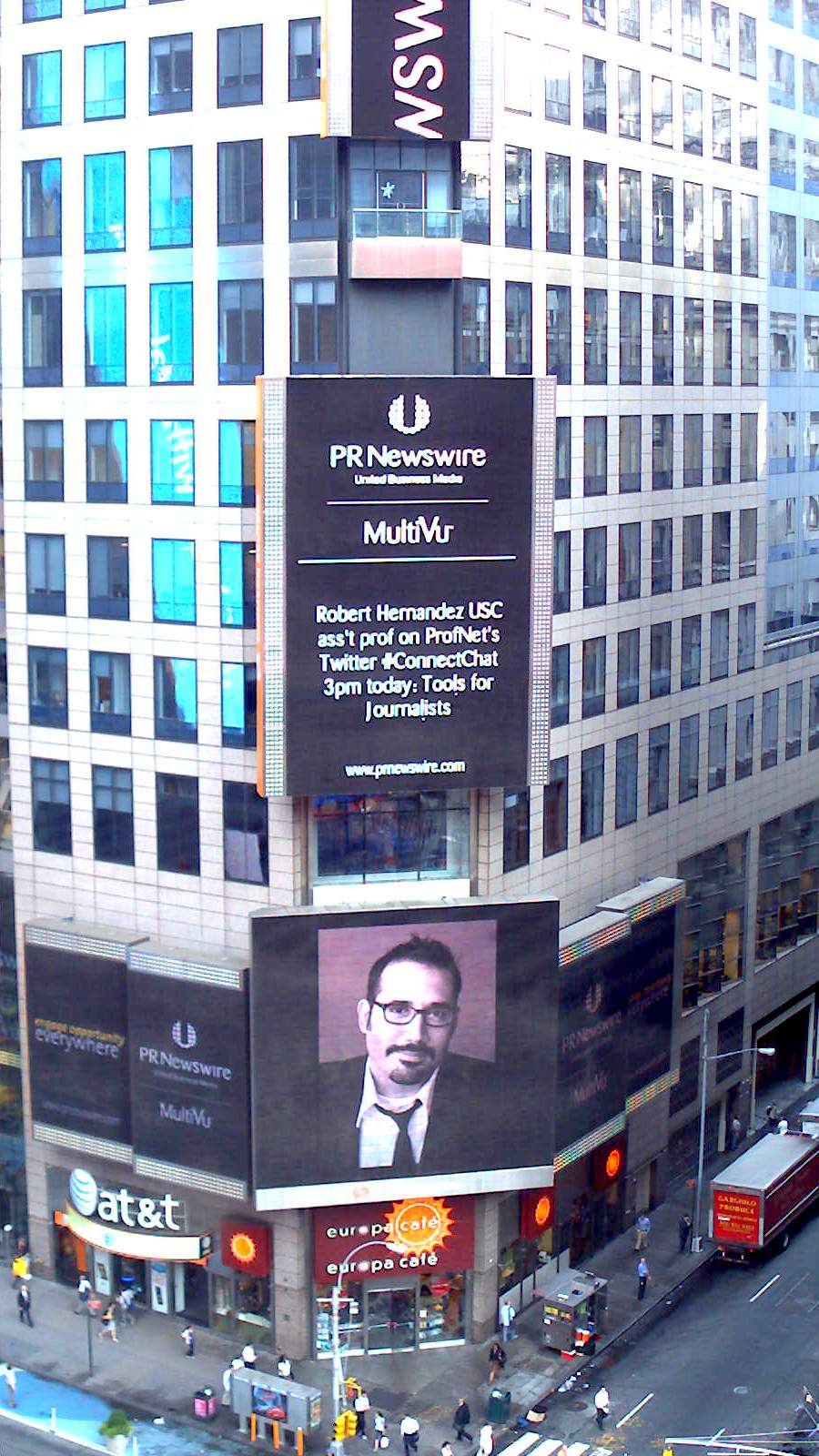
As part of the promotion for #connectchat, a Q&A conversation conducted by PRNewswire’s ProfNet and held on Twitter, they posted my mug on the side of the Reuters building in New York’s Time Square. Not exactly sure I merit this, but I will say this is as awesome as it is awkward.

Question: Is it “at,” “on” or “in” Time Square? Please advise.

Categories: Personal Tags: