Archive

Author Archive
05 Mar

Los Angeles Times: One edition, lots of great photojournalism (and stories)

Comments off

NOTE: Republished on Online Journalism Review: http://www.ojr.org/ojr/people/webjournalist/201103/1952/

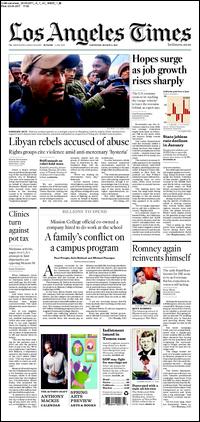
Los Angeles Times' frontpage 3-5-11My wife and I recently decided to subscribe to the newspaper again. We’re ‘weekender’ subscribers to the Los Angeles Times. Like most papers, the size is a fraction of what it use to be, but the content is as diverse as the city it covers.

I, like most modern news consumers, have not had much time to actually sit down with the paper product, even through we only get it Thursday through Sunday.

But today, over the breakfast table, we get our fingers dirty with ink print (which I love) and dug in.

I could not ignore the great, diverse photos that filled the paper – the majority of the great shots from staff. So much so, I had to write this post.

In this one, random edition [Saturday, March 5, 2011], I found great photos throughout the sections of the paper. Check them out below… all of them, but one are available online.

Back in Libya after decades in exile, a dissident takes on Kadafi

Since his return in late December, a longtime opposition group leader has become more vocal in his denunciation of Moammar Kadafi. But some experts say such groups have been gone too long to be of much help to the rebels in the streets.

Back in Libya after decades in exile, a dissident takes on Kadafi

Anwar Magariaf fought from abroad against Moammar Kadafi's rule for more than 30 years. (Rick Loomis, Los Angeles Times / March 4, 2011)


[NOTE: Looks like the photo was removed from the site.]

Founder of Crescendo charter schools fired

John Allen is accused of promoting cheating on standardized tests; L.A. Unified closed all six schools in the group.

Just after the charter group’s governing board decided unanimously to fire him as executive director, John Allen, founder of Crescendo schools, leans against a wall. Shortly thereafter, he left the meeting. (Brian van der Brug / Los Angeles Times / March 4, 2011)

Just after the charter group’s governing board decided unanimously to fire him as executive director, John Allen, founder of Crescendo schools, leans against a wall. Shortly thereafter, he left the meeting. (Brian van der Brug / Los Angeles Times / March 4, 2011)

As L.A. tourism rebounds, tour buses bring noise and gridlock

Residents of Beverly Hills and the Hollywood Hills complain that an increase in tour buses — crowded with photo-snapping visitors — is clogging narrow residential streets.

Reflected in a bus mirror, visitors Sharon Butchart of Uxbridge, Canada, left, and Miriam Leiser of Ramsey, N.J., use headphones to listen to their tour guide. (Liz O. Baylen, Los Angeles Times / February 23, 2011)

Reflected in a bus mirror, visitors Sharon Butchart of Uxbridge, Canada, left, and Miriam Leiser of Ramsey, N.J., use headphones to listen to their tour guide. (Liz O. Baylen, Los Angeles Times / February 23, 2011)

Aaron Liberman hopes to lead Valley Torah to a first for Jewish schools

Aaron Liberman and his brother Nathaniel earn kudos for their work ethic as Valley Torah prepares for 6AA Southern Section basketball championship game against Bishop Diego on Saturday.

Brothers Aaron and Nathaniel Liberman after a recent Valley Torah practice in Burbank. (Gary Friedman / Los Angeles Times / March 2, 2011)

Brothers Aaron and Nathaniel Liberman after a recent Valley Torah practice in Burbank. (Gary Friedman / Los Angeles Times / March 2, 2011)

Don Bartletti / Los Angeles Times

Don Bartletti

Only part of portrait photo, taken by Don Bartletti / Los Angeles Times, of ornithologist Peter Harrison is seen in the archive and sadly not available online version: Scientists announce discovery of new species of seabird, the first in 89 years

To be fair, there were some great stories too, especially the ones paired with the photos. From the latest on Libya to California having the highest gas prices in the country to LAPD’s dilemma with Charlie Sheen, a good mix of stories that caught my (limited) attention. My favorite, though, was this piece my wife spotted inside business: Spiders in Mazda cars still a mystery (print headline)

I have to say, this experience reminds me of an incredibly powerful piece by Robert Niles in OJR a few months back: Letting go of the rope: Why I’m no longer a newspaper subscriber.

In it he used the strong imagery of letting go of the rope while someone, who asked for help but failed to do anything to improve their situation, was still holding on. The person on the rope was the newspaper/news industry.

Personally, I think Niles forgot something.

Yes, the news industry needs to do more to get itself out of the situation. But, the only person he saw on the rope, in my opinion, was the leadership.

What I think Niles missed are the hundreds of people trapped under that leadership … the ones that are passionate and believe in the value of their craft… the ones that — even after layoffs, furloughs and bad pay – come to work every day, working long hours to tell the stories of the community in text, photos, videos or whatever form the best they can.

Journalists that are as frustrated as Niles, but are trapped under that leadership. Journalists that choose not to let go of the rope. Journalists that are trying to do what they can with what they have … in most cases, “more with less.”

Don’t get me wrong. There’s a lot of crap too (Check out Churnalism.com). There is a long way to go to make this better. I’m also as frustrated as Niles is with the leadership.

But I can’t lump the great, good or even mediocre work journalists do across the country every day and night with the bad leadership and poor business decisions that have undercut them and our industry.

I’m just a weekender, and for this one edition, I’m glad we re-subscribed.

11 Feb

How did you experience Egyptian news and history?

Comments off

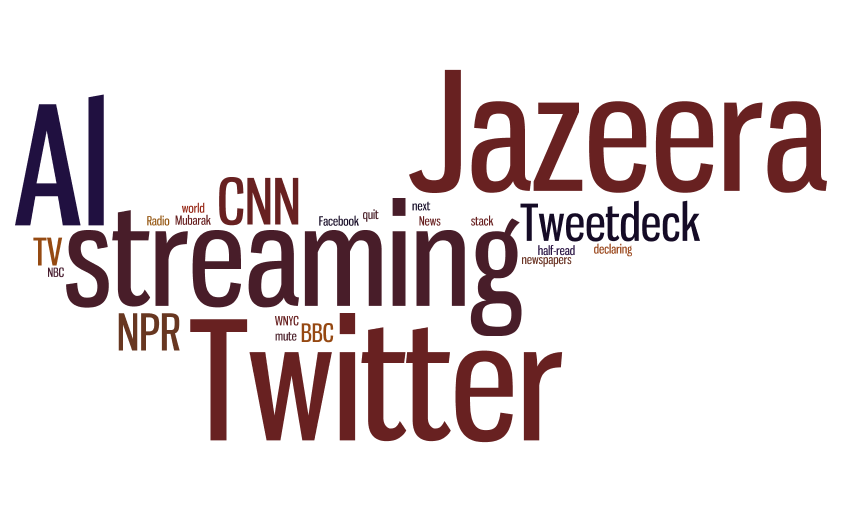
I asked the ‘Twitterverse’ to share what sources they were using to experience the historic news of events from Egypt. Here is a Wordle showing the response.

Al Jazeera was the clear winner.

10 Feb

Mubarak ‘stepping down’: Dissecting a media echo chamber

NOTE: Republished on Online Journalism Review: http://www.ojr.org/ojr/people/webjournalist/201102/1942/

Here is an attempt to break down the timeline of today’s news from my point of view. Please note that this mainly reflects Twitter and my experiences. I’ve used Twitter’s advanced search, which isn’t great, and gotten some crowdsoucing help. Please feel free to contact me to make this more accurate.

P.S. This is my first Storify … be gentle.

10 Feb

Two voices committed to our calling

Comments off

NOTE: Originally ran on Online Journalism Review: http://www.ojr.org/ojr/people/webjournalist/201102/1940/

Let’s face it. In our industry, we are surround by haters. From our newsrooms to the classroom to nearly any room, there are people that have been claiming journalism is either dead or dying.

In all that noise, I find it refreshing to hear the voices – strong voices – that are committed to our calling. For this week’s post, allow me to introduce you to two voices that are committed to what we do.

They are not spokespeople for the industry or an emerging trend or an oddity … they are just two different people that can’t deny their calling.

I first “met” Khadijah Britton, the founder of Better Bio, when I crowdsourced “Why I am a journalist” project. She called in and shared her story.

Liana Aghajanian I also “met” through Twitter. Even though we both live in Los Angeles, we have yet to meet. She if the force behind an independent Armenian publication.

Both of their stories inspired and reminded me why I am a journalist. Here is our Q&A conversation from a few weeks ago:

What is your current job/relationship with journalism?

LA: I am currently a full-time freelance journalist writing for a number of online and print publications, including Los Angeles Times Community News and Spot.us. I’ve also written for New America Media, Paste magazine and most recently, EurasiaNet. I also run my own news magazine (www.ianyanmag.com) which focuses on issues related to Armenians and the South Caucasus, and occasionally the Middle East.

KB: I am founder, CEO & Executive Director of BetterBio.org, biotech news in the public interest. My relationship with journalism is a bit more complicated, in that I am concurrently applying for fellowships and freelance reporting jobs so I can pursue my own investigative reporting, which at times goes outside of the realm of biotech into human rights journalism. It is also more complicated in that I am not only a “hack” but a “hacker” and am developing web and mobile tools to support a new and better journalism world. One of the tools I am working on is called “TipTapestry” – my team applied for the Knight News Challenge to fund it, and it can be seen at the Knight News Challenge site.

What were you doing before this stage of your journalistic career?

LA: I was an editor for a new media company where I worked with freelance writers and collaborated with publications like the Atlanta Journal-Constitution, a few Hearst newspapers and online publications.

KB: I was at law school, studying at Boston University. My focus was on biotechnology patents – the complexities involved with patenting life. I mostly went, however, to improve my writing! Law school teaches you to write tersely under a deadline like little other training. I’m still wordy, but much less so, now.

In one way or another, it seems like you “stepped away” from journalism. Can you tell me what first lead to you “stepping away?”

LA: Well, I don’t know if I necessarily ever stepped away in the real sense, but you could say that I was in a segment of the media industry that I did not want to be in, and that wasn’t because I changed, but because the industry did. I graduated out of journalism school right when the industry fell apart and began bleeding reporters. I had to adapt and so I was offered a position that while still was in the media industry, was also far removed from the long-term goals I had planned for myself, chiefly that of working in news.

KB: I stepped away from journalism before I ever began, in a way. I purposefully never went to J-school and never engaged with mainstream publications because I did not respect what the establishment media had become. I helped found four publications in my 20s, and co-founded two film companies, so I never stopped doing the work of journalism. But I definitely made a conscious choice not to do traditional journalism as far back as when I was twenty. I then re-committed to doing things differently after I took a job at what I thought was a health and life sciences publication that was really just an advertorial source for mid-cap medical device companies to promote their discoveries to larger companies. That experience left me sickened – I learned so much about this industry and could report none of what I learned. I felt like I was choking. So I moved into the field broadly known as “human rights” or “advocacy” reporting – acting as a media [liaison], researcher and report writer for nonprofits and advocacy organizations such as Healthcare for All and Human Rights Watch. My work in this field led me to law school, where I thought I could learn how to better investigate the corruption to which I bore witness. I was right, it did teach me that – but it also taught me how to think and act with greater discipline. Law school gave me the confidence that I could succeed if I forged my own path. That, and there was nothing else to do – there were no jobs! So I thank the fates for the recession’s impact on my career.

Can you tell me what “got you back” into journalism?

LA: Around two years ago, I decided that I wasn’t going to let my full-time job necessarily limit me from doing what I really wanted, which was reporting, so I began devoting all my energy after work and on weekends to pitching publications, establishing relationships with editors in an effort to get myself out of my (stable) comfort zone and on the ground running again. I also started to run my own online publication that has grown by leaps and bounds in just a few short years.

I did all of this because I have known since adolescence that my role in life was to be a journalist. It was all I wanted, all I dreamt about and all I imagined for my future, and I wasn’t interested in letting the economy, or a change in industry change who I wanted to be. My 40 hour work weeks turned into 80 hour work weeks. When I wasn’t reporting and writing well into the hours of the night, I was developing story ideas, blogging, taking photos and video as well as coordinating with freelance writers who were interested in contributing to my site.

KM: Last September, I got a call I did not expect – it was my supervising partner, and he sounded terrible. When I asked what was wrong, he said he couldn’t believe what he had to tell me – that he felt nauseous – but the firm where I had worked could not afford to offer me my position. I sulked for a few weeks – if I was to work at any law firm in the country, it would have been that one – but then I started to get excited. My future was unwritten and was now mine to write! I began brainstorming my future with a close friend, David Thompson, who was at a similar point in his life, while volunteering at various organizations that worked on improving access to medicines and helping indigenous people with intellectual property issues. Some of the nonprofit work I was doing was written up in Bloomberg – quite poorly – and it sparked a fire of rage in my belly: I wrote a letter to the poor author deriding his lack of journalistic rigor and integrity and lecturing him on best practices. He was surprisingly gracious in accepting my feedback. One hour later, my friend David Thompson shared another story on Bloomberg – the Pfizer feature by David Evans – and I had the dramatically opposite reaction: this time, my heart raced not out of anger but of excitement – this, THIS! was investigative reporting! I wrote him a fan letter – and, for the second time that day, received a shockingly gracious response. He somehow figured out I used to cover medical devices, got me chatting, and I was immediately hooked. It was the strangest thing – seeing the best and worst in journalism within an afternoon, and realizing how goddamn much I cared, was all it took to pull me back in. I was finally ready to do something about it. To make my mark.

You’re not the spokesperson for journalism, but what is your response to people who are doom-and-gloom about our industry?

LA: I understand it. It’s a natural reaction to have I suppose.

I think it’s entirely OK to have negative feelings. It’s normal. When you let those negative feelings hinder you, is when the problems begin.

In the end, doom and gloom has never accomplished anything for anyone. The only way to learn, grow, recover and progress is through determination, focus and intrepidity. Our industry has not gone away. It is not doomed. It is changing. As journalists, we have to learn how to adapt to these changes. It’s not the vessel that’s important, it’s what inside, and from my experience, people still care a great deal about journalism – it is still a noble, worthy cause that will survive only if those entrusted with its powers can manage to become innovative. Call me an optimist, but I truly believe that.

KM: Doom and gloom are the reaction of those who are at once ashamed of their own culpability and unwilling to change. I pity the fools. Storytelling is what we do. We all find each other fascinating. We find the world fascinating. It’s one of the things I love about being human. Writing these words and knowing that you will read them gives me a rush. It’s the rush of connection – the possibility of a spark – of some new idea or empathy or delight being ignited by my words. We do not write just to dictate down what is happening – if that was all reporting was, we’d just install surveillance cameras everywhere like the cops do and choose a location to watch. Heck, even better – we’d have action buttons at those locations that citizens could push to tell others that SOMETHING IS HAPPENING. But no, that’s not what we want. We want context, interpretation, analysis, discussion, opinion, [vitriol], hyperbole – as humans we want a million journalisms depending on the type of story, depending on our levels of education – and, most importantly, depending on how much we trust the source. I know that I will accept much more jocularity, absurdity and emotion from someone I trust than I will from an unknown source. When I do not know or trust the source, then it’s just the facts, ma’am and here’s my footnotes. We are entering an era where both of these – “soft” and “hard” reporting – can finally coexist and nourish one another without driving us all batty. CNN’s scrolling drives me nearly mad (I tune it out), but if I can instead opt into getting more background on the story by clicking to a “background” section, or discuss it with my peers on a related discussion board, I will engage with that story so much more.

Are there any words of advice you’d like to share with people who are debating what to do with their journalism career?

LA: I find it difficult to give advice, because in many ways, I am still learning myself, but the advice I have is this: If you really believe in journalism, if you believe whole heartedly that it is pumps in your veins, then stop at nothing (and I mean nothing) to pursue your career. This industry is crazy, you will love it more than it will probably ever love you, but if you don’t stand up for yourself and actually try to do what you love in it, you will regret it.

Mark Twain once said, “Twenty years from now you will be more disappointed by the things that you didn’t do than by the ones you did do.” That’s pretty accurate and sound advice.

The most important element is not giving up, if you keep pushing forward, you can achieve [anything] you want to.

KM: I am biased, obviously, but I recommend that everyone get involved with a nonprofit news startup at some level. This moment – this exact moment – will never happen again. The promise and potential, the uncertainty, of the new journalism world is so exciting! And as a journalist, you’ve gotta be an adrenaline junkie (at least starting out!) so why not put all of that beautiful adrenaline to its best use? Figure out what story you want to tell and go help someone who wants to help tell it. Otherwise, in my opinion, you’re probably wooing a corpse.

What do you hope to achieve in your journalistic career? What is success for you?

LA: In a broader sense, I hope to be able to write stories that I am proud of. Stories that can have an impact, stories that fall under a category I like to call “chill-inducing journalism.” I am interesting in human rights, poverty, immigration, environmental and international issues of importance as well as culture and ethnicity and I hope I can produce amazing work with regard to all, some or a few of those categories, work that can be appreciated by those that journalists really serve: the public.

Success for me would mean being able to not only write, but write well in the publications that have for me, epitomized good journalism, and that list would include the Los Angeles Times, New York Times, Mother Jones, the Center for Investigative Reporting and the Guardian among others. It would also mean achieving success as a foreign correspondent in a few countries that are of particular interest to me. Success would mean having the career that the amazing Mr. Nicholas D. Kristof has had.

But I suppose, most of all, success would mean being a respected member of an industry that is and always will be at my core.

KM: Success to me would mean creating news about science and business that truly COMPELS low-income people without science or business educations (which is to say, most of us) to look under the hood of our life sciences industries. To spark their INSATIABLE curiosity. And to get their voices into the policy conversation at the highest levels – to use journalism as a tool to empower the people impacted by the news to actually not only read but create the news. I hope to do this through creating and nurturing exceptional content, training teens and life-long learners in science media literacy and citizen science reporting, and creating awesome fora for online and offline engagement. If we can get an inner-city teen and a rural mom and a hospitalized elder to all join the conversation, I’ll consider my life and work a success.
Categories: Journalism, OJR Tags:
02 Feb

Is Social Media Gutenberg or Guttenberg? It’s actually both

Comments off

NOTE: Originally ran on Online Journalism Review: http://www.ojr.org/ojr/people/webjournalist/201101/1936/

Social media means different things to different people.

For some, tools like Twitter are at the Gutenberg level, while others place it at… the Guttenberg level. (Sorry Mahoney)

But the “debates” on whether it is the next printing press that causes revolutions around the world or the next Police Academy 3: Back in Training, focusing on what we’re having for lunch, to me, are looking at it wrong.

When I teach how to use social media for real-time reporting, I tend to get some of the same questions and comments either praising or dis’ing these applications.

– Why do I want to know about what celebrities had for lunch?

– It’s what caused the mass protests in Egypt, right?

– Doesn’t it hurt your relationships in real life?

– Twitter is the news source. Traditional news orgs are screwed.

Not exactly.

Twitter, Facebook and other social media applications have greatly affected our lives and influenced our culture… but, remember, it’s just a platform. A tool. An appliance, if you will.

I tell folks to frame social media apps just like a telephone.

There are hundreds of incredibly insightful, powerful conversations happening over the phone right now. But, there are also several thousands of mundane and truly painful “conversations” as well.

It’s not the telephone’s fault. It’s how people use it.

Extend this clunky metaphor to radio, TV, and printed publications. There is quality and there is crap. But, without a doubt, these platforms have each enhanced the way we communicate, share information and interact.

I was lucky enough to be in Washington, D.C., when Egypt erupted. D.C. is one of the few cities that carries Al Jazeera English.

With the news network on the television set and Tweetdeck launched on my laptop, I watched the coverage unfold, noticing that the station’s live coverage was the fastest and most complete news source. And, as they reported, I and other viewers tweeted/retweeted.

A few days before, I had seen someone once again claim that Twitter is the news source. In my opinion, it really isn’t. It’s a great aggregator where news and information – accurate or not – flows fast. But the “news” on Twitter tends to be coming from traditional news media.

Twitter is an invaluable platform. But it’s not really the source.

For the most part, when it comes to news, the source/content comes from traditional news sources. And that information gets shared with a vast network of users.

There are powerful reports from the ground, but the impact of the situation, for me, is really felt through the news sites.

So, it’s not the source, but it is one incredibly powerful platform.

We’ve all seen these headlines calling an Iranian Twitter revolution, Tunisia cyber-net revolution and, certainly now, Egypt’s social media uprising.

It’s a narrative many in the media are in love with, even though it cheapens the fact that people are risking more than just their Internet access. They are doing more than updating their status and streams.

There is no doubt these tools were used in all these historic events, but I would encourage us to be a little more hesitant in crediting it as the cause.

I imagine that this narrative was used when the printing press, radio or television were first introduced… a revolution caused by the platform. And I imagine that this is just a phase where a shiny new platform is an easy narrative to jump on.

But here’s the thing. It’s not an either/or issue. It’s both. The platform has facilitated the organization of the masses and empowers them to distribute the information in a new way.

There are lots of people writing about this topic. Here’s a collection of different points-of-views:

http://gigaom.com/2011/01/29/twitter-facebook-egypt-tunisia/

http://gov20.govfresh.com/a-tunisian-on-the-role-of-social-media-in-the-revolution-in-tunisia/

http://motherjones.com/interview/2011/01/evgeny-morozov-twitter-tunisia

http://www.thedailyshow.com/watch/thu-january-27-2011/the-rule-of-the-nile

My point overall is a simple one: Credit the people, acknowledge the platform, but put it all in perspective.

25 Jan

Carnival of Journalism: Two vital journalism institutions working together

Comments off

NOTE: Originally ran on Online Journalism Review: http://www.ojr.org/ojr/people/webjournalist/201101/1934/

NOTE: This is my entry – late entry – to the Carnival of Journalism, a collection of blogs writing on a single topic, organized by Spot.us creator David Cohn. This is a revival of the Carnival and in this first, returning edition, the topic is “The changing role of Universities for the information needs of a community.” I decided to approach it from my recent experience in the academic world following my time in the newsroom. You can read the round up of other entries here: carnivalofjournalism.com

Newsrooms, meet classrooms. Classrooms, meet newsrooms.

I know you’ve known each other, tolerated each other and have even talked smack about each other for decades. But guess what, you both need each other.

And you both need to change, adapt and evolve fast.

That’s my conclusion as I start my fourth semester in academia, after ten years in newsrooms. (For the record, I don’t consider myself an “academic.” I prefer the term “hackademic.” Actually, I prefer Web journalist.)

I know in newsrooms we’re busy putting out the daily miracle (every 15 minutes online) and are always short on resources. We are on the leading edge of content evolution online, but we don’t have time, money and, sometimes, the skills we need to experiment and grow. We often don’t have support from the top either.

Let’s be honest, we often dismiss academics (those who can’t, teach) and have some issues collaborating with anyone, whether be it another newsroom or a university.

I know in classrooms we put in longer hours (even though people don’t see it) working with aspiring journalists. These students are called the future of journalism on a good day, but are dismissed as clueless dreamers on a bad day – often called both by people in the newsroom.

I know that the “students” that fill our classrooms are no longer students, but journalists. And, while they are surrounded by haters (from parents to working journalists to even professors), this force of young journalists can’t be stop. Thank god.

I also know that in academia there is some time to think. We have more time to reflect and share those thoughts. We actively are talking about journalism … even though some may have not practiced it in some time. Does that mean their analysis is invalid? No… but some people do dismiss it.

Often, but not always, academia has access to grants and more funding. My jaw has dropped when I’ve heard about the amount of money funding some projects that didn’t deliver. I know in newsrooms many of us would make miracles happen with a fraction of that money.

On the other hand, when funding is given for something innovative, well, some in academia have not innovated in a while. Don’t get me wrong, I think there are more professors that are “getting it” more than leaders in the newsroom. But being innovative and risk-taking isn’t something that is always engrained in every tenured professor.

Let’s be honest again, we in academia often dismiss those in the newsroom as being arrogant and unaware that they need help. I know many of us have spent years trying to partner with local newsrooms, only to get frustrated and give up.

Both sides are imperfect. Journalism is imperfect.

Both sides need to evolve in their own way. Journalism needs to evolve through them.

Both sides need each other. Journalism needs truly them.

So, how do we do it?

A classroom, in essence, is a newsroom full of hungry journalists that don’t want to talk about journalism… they want to do it.

Professors need to empower these people to produce work, not just for their class, but for the community. These pieces should not be solely read by the person standing in front of the classroom. They need to be read by the public. And as there are cutbacks in our newsrooms, journalism classrooms need to help fill that void.

Folks in newsrooms need to join forces with the classroom. If we really want to diversify our staff, let’s take an easy step and partner up with a class that can work on a project we literally can’t afford.

Academia needs to actively offer training to local newsrooms, especially the smaller ones. Ethnic media needs your help.

Hey, editors and publishers, get training for your staff. And by reaching out to your local universities and community colleges, you’ll get it… as well as building a mutually beneficial partnership.

Every semester, a classroom is swarming on a neighborhood, a beat and story theme. While we are publishing them on our student media, others should republish them when appropriate.

Research and develop together. Universities are filled with smart people wanting to work on a good project. Newsrooms are filled with smart people who identify needs, but don’t have time to work on these great potential projects.

Yes, we are seeing these types of partnerships popping up and growing. But, quite honestly, it’s just scratching the surface.

So, what are you doing Hernandez?

Well, I’ve tried to have my class produce community journalism. This semester I hope to partner with a local news org to get their pieces published.

In terms of innovation, I’m working with a group of amazing developers that believe in the potential of joining forces for the betterment of journalism. We hope to do R&D for the industry.

We need more. And all it usually takes is a conversation and a commitment.

Imagine how much better our journalism will be if these two vital institutions worked together.

Actually, stop imagining and start doing.

19 Jan

Crowdsourcing ‘web journalism rockstars of color’

Comments off

NOTE: Originally ran on Online Journalism Review: http://www.ojr.org/ojr/people/webjournalist/201101/1931/

For this week’s blog post, I chatted (through e-mail) with up-and-coming journalist Emma Carew, the driving force behind a new Web journalist of Color spreadsheet.

Recently, there seems to be an ongoing conversation about diversity in our newsrooms (especially Web newsrooms) again. One of the results from that conversation is the spreadsheet you created. Can you describe this project and how it came about?

Following Retha Hill‘s post on MediaShift IdeaLab about diversity at recent ONA and Newsfoo conferences, I was excited to weigh in during the Twitter chat on #mediadiversity. People mentioned hearing, “we can’t find any qualified minorities,” for speaker presentations and conferences. I was shocked to hear this, because I could have easily listed a dozen or more journalists of color doing amazing things with journalism and the web — these are people I look up to, who have mentored me. We all left the chat on Twitter promising to take action and spread the good word. A few days went by and when no list to promote these fine folks appeared, I knew it was something that I could initiate. By reaching out to my network, we were able to assemble about 75 names, all top-notch journalists of color working with journalism and the web. Anyone looking to put together panels of amazing journalists looking to share their story, no longer has an excuse for putting together an all-white, all-male conference.

How have the names been selected? What has been the process? Is there a general criteria for who makes this list?

About eight contributors are continuing to cultivate the list, which is open for public viewing. Anyone can nominate themselves or others by contacting one of the authors. Our loose criteria have been these: journalists of color, doing great work in web journalism, and who would have something interesting to share on a panel. The goal is to identify as many web journalism rockstars of color as possible.

NOTE: Full-disclosure, I am one of the eight that curates the list and am also hosting the spreadsheet on my server. Others include Sharon Chan, Michelle Johnson, Doug Mitchell, Juana Summers and Benet Wilson.

What is your vision, your goal for this project? What would you like to see happen here?

My hope would be to see better representation of journalists of color, both as attendees and speakers, at journalism conferences such as the UNITY organizations, SPJ, ONA and IRE. The leadership of these associations have a great opportunity to widen their circles. I’d love to see the project embraced and promoted by the national journalism leaders. Diversity shouldn’t only be a priority for the UNITY groups.

Diversity is more than ethnicity. Is there any thought to expanding the spreadsheet to include gay/lesbian, women or other communities that are under represented in our newsrooms?

I definitely agree, and we are certainly open to representing diversity of all types. In the current setup, there are eight authors who are collaborating to keep the list organized and “vet” the names when we come across an unfamiliar name. We currently have representation of some kind from all four UNITY organizations. If there are leaders (official or unofficial) from NLGJA or other journalism associations who would like to get involved, please contact us.

So what has been the reaction to your project so far?

I think it’s been well received in the smaller UNITY org circles. The list is growing slowly and each of the authors has continued to reach out to leadership in our respective associations. It’s an important time for the list to be circulating and continue the conversation with summer journalism conventions coming up.

What have you learned from the project?

Working on this project has been a great reminder of a few things. First, being that it’s not enough to idly sit by and try to tweet the the change you want to see. At some level, you have to just take a leap and try. This project has also been a good reminder of the importance of good mentors. This project would not have gotten off the ground as neatly or quickly had it not been for some excellent guiding hands

Tell me a little about your journalism background. I hear you recently took a new job.

I got my start in journalism at a high school program called the Urban Journalism Workshop, now called ThreeSixty Journalism. During college, I interned at the Star Tribune, the Pioneer Press, the Washington Post and the Chronicle of Higher Education, mostly focusing on business, education and data journalism. I spent six months working for the Chronicle of Philanthropy working on data projects, especially on how to best present them online. Next week I will be joining the startribune.com team as a home page producer.

The struggle for journalism diversity has gone for years, decades even. How have you personally benefited by those who have worked hard for diversity?

The program I got my first start has its roots with the Twin Cities Black Journalists association (our local NABJ chapter). From the start, I was surrounded by talented journalists of color who had an interest in my success. Being a member of AAJA for six years has filled in the gaps of all the things they forget to teach you in J school: networking, mentorships, how to be a great intern, and how to fight for the things you believe in. I’m grateful to those who have blazed the trail before me, and I’m excited to continue in their path. There’s still a lot of work to be done around diversity in the media.

When I can, I like ending my interviews with journalists with the same question … In an environment of furloughs, layoffs and budget cuts… where we work more with less … in these ‘tough times,’ where we are in constant evolution … Why are you a journalist?

Unfortunately as a first-year reporter, these times are the only ones I have ever known firsthand. I remain an optimist, especially the more I move toward digital and multiplatform work. I firmly believe in the need for excellent journalism in our communities, for it’s role as a watchdog and the art of our storytelling. I became a journalist because it was the only career I have ever considered. I remain a journalist because I know our work is far from done.

Thank you so much Emma. You should be really proud of the work you’ve done, especially this project.

Robert thanks so much for all your work on this. It’s been a great experience and I hope to see its success play out.

12 Jan

Errors happen – it’s what’s next that matters

Comments off

NOTE: Originally ran on Online Journalism Review: http://www.ojr.org/ojr/people/webjournalist/201101/1928/

On Friday, December 13, 2002, I killed a man… a teenager really… but only for 15 minutes.

I was a few months into my new job at The Seattle Times where I was running the homepage. The news broke that a 17-year-old teen was shot in the head by a Seattle police officer during an attempted robbery and the brief was sent my way to post.

For some reason, I assumed a gunshot to the head was fatal and wrote the headline stating that the teen was killed.

After getting rightfully chewed out by the reporter, I learned that you can survive that injury.

More than eight years later, after hearing the news coverage and premature reports of Rep. Gabrielle Giffords’ death, I can’t help but be reminded of my error and the lessons I’ve learned.

Throughout my career, I’ve heard people say that the Web – and now the real-time Web with social media – is a liability. A “tangled Web” of ethical problems.

Let’s just get this out-of-the-way: Errors happen in journalism all the time and, for the most part, by accident.

It doesn’t matter what the medium is – pixels or paper, newswires or tweets – facts can be misled, misreported or misunderstood. Errors happened before the Internet. Errors happen in newspaper, radio and TV journalism.

The bottom line is that errors happen.

What matters, in my opinion, is what you do after they happen.

After profusely apologizing, I fixed the headline and immediately wrote up a correction. It may have only been 15 minutes and perhaps only a handful of readers may have seen it, but it didn’t matter. I made the mistake.

You know that debate about who is a journalist and who isn’t? It’s all pointless really. When it comes down to it, a journalist, in its true essence, is someone who has credibility in delivering accurate information. It’s the person you can trust because they have earned your trust through accuracy.

Credibility is such a fragile thing. Takes years to build, but just moments to lose.

But in a craft where facts are moving quickly and readers want information in real-time, it’s not the multimedia or tech that counts… it’s your credibility.

I made an error that dinged The Times’, the reporter’s and my own credibility. Immediately posting that correction was a small, simple act of transparency to own up to it.

If you think about it, journalism is based on such a fragile thing like credibility. Trust. Faith.

The reporter, covering a news event, has to find the right sources and trust – yet verify – the information they are collecting. The reporter’s editor needs to trust that the reporter is not making this stuff up or stealing it from a competitor. The process goes from stage to stage until it gets to a reader/viewer/listener/user who then has to trust whether or not the piece is accurate.

Trust but verify. Consider the source. If your mom says she loves you, check it out.

All that before you hit publish to print or tweet your piece. All that as you consume a piece of news.

Like more and more people, I experienced the Giffords news coverage through a variety of ways that included radio, web, TV and social streams. I heard the incorrect reports about her death and the reactions that followed. I also heard the incorrect reports about her speedy recovery and those reactions.

I highly recommend reading Regret the Error‘s piece that breaks down how the error spread and Lost Remote‘s on whether or not incorrect tweets should be deleted.

Make sure you read the response by NPR Senior Strategist Andy Carvin, who talks about his role in tweeting the incorrect reports.

While mistakes were made in the coverage, the discussions afterward have been productive and insightful.

The errors happened. But what also mattered was what happened afterwards.

Categories: Journalism, OJR, Real-Time Web Tags:
07 Jan

Digital + Diversity: What does your newsroom reflect?

Comments off

NOTE: Originally ran on Online Journalism Review: http://www.ojr.org/ojr/people/webjournalist/201101/1926/

If you ask a Web journalist what the newest, important tool a news organization needs to embrace today, they’d probably say Social Media. They’re right, it’s not a fad.

If you were to ask them to make a prediction or guess where the future of technology is headed, chances are they’d say mobile. Smart phones are getting smarter, smaller and cheaper. (And, one day Verizon will carry the iPhone – I believe!)

If you were to ask me what one element newsrooms need to embrace, outside of technology, my answer is a simple one: diversity. Can we make that a New Year’s resolution?

I’m not talking about being politically correct. I’m talking about having diverse experiences and points of views that shape and literally define what is news.

I believe that the lack of diversity – gender, age, religion, sexual-orientation, socioeconomic background, politics, bus riders, cyclists, video game addicts, etc. as well as ethnicity – in our newsrooms in all roles, especially leadership ones, is one of the main causes of lower circulation and loss of general reader/viewer engagement.

Again, I’m not talking about being politically correct. I’m just saying if we are not made of all our communities, how are we expected to relate and be relevant to all those communities?

Let me give you an example:
One of my early Web specials I did in my career was the 20th anniversary of the AIDS epidemic. I was representing SFGate.com as I sat around the table with print reporters and editors. You have to understand, the San Francisco Chronicle was crucial in the news coverage twenty years before with the incredible work by Randy Shilts.

These people were professionals and I was still the relatively new kid working with that new medium.

But as they spoke, I noticed that all the stories were about gay, white males. No one talked about that the fastest growing HIV/AIDS demographic was straight, black females.

They were the pros. I was just a punk kid.

Staying quiet is one of my biggest regrets in my career. I swore no matter how awkward or uncomfortable, I had to always speak up.

That chair I was sitting in wasn’t just for me. It was for all the communities I was a part of… and all the others that I wasn’t, but weren’t at the table. I have to rep everyone. You know, that voiceless thing.

Here’s another example:
Do you remember when someone tried to reinstate the draft back in 2003? I was sitting at the morning news meeting as the draft talks began to heat up and we started brainstorming on how to cover the story.

In a room of incredibly talented and experienced journalists, the angles included talking to teachers, parents, Vietnam vets, recruiters … but I was shocked that well into the discussion I had to raise my hand and mention, how about talking to high schoolers?

The room forgot to include the demographic that was going to be most affected by the draft.

But the lack of diversity in newsrooms isn’t new. Women have been battling the glass ceiling for decades and studies, like the one from ASNE, have shown a depressing lack of ethic diversity for years.

So, why am I bringing it up?

Let me give you another example:
In a recent PEW study, it found that African-Americans and Latinos “are more than twice as likely to use Twitter as are white internet users.”

In several not-so-recent studies, they found that Latinos are ahead of the curve in embracing mobile devices and its behavior. They are more likely to text message, download music, play games and access social networking.

Yet, how come there isn’t a reflection of that diversity in those Web journalism jobs? While there is a lack of diversity in newsrooms, why is there even more so on the Web side?

The digital divide? Sure, but not the one you are thinking. Those studies show “minorities” are on the advanced side of the divide and others are behind.

Diversity, and the possible lack there of, was raised as a concern after the recent invitation-only Newsfoo submit.

At last year’s SXSWi panel about the future of news it was all white men.

Look, I’m not saying that your ethnicity or gender or whatever is a requirement to do a better job for any of these tasks.

What I am saying is that if we don’t reflect our communities – both on- and off-line – we’re doomed. If we don’t listen to others outside of our own, individual communities we’ve missed the point of journalism.

This isn’t about hiring “us” over “them” … this is about how all off us strengthen journalism by reflecting our diverse communities through relevant coverage … and that the coverage is shaped by those that make up the newsroom.

That’s the premise of hyperlocal journalism, isn’t it? That a local or insider would know what is more relevant to their community rather than an outsider.

So, why can’t we overcome this challenge? It’s 2011.

PBS’ MediaShift recently held a Twitter chat on media diversity.

Thankfully, it’s on people’s minds again.

I routinely get asked for names of diverse candidates to apply for Web journo jobs… but here’s the thing, while I know plenty of reporters, editors photographers, etc., my network of diverse Web journos isn’t as strong as it should.

Y’all, I’m a lifetime member of the National Association of Hispanic Journalists, board member of Online News Association, been to nearly every alphabet soup of conferences and I’m still struggling to diversify my Web journo network.

So what do we do about it? We need more solutions outside of forming another damn diversity committee.

The fact is, these diverse communities are already on the advance side of the tech divide… but they are not on the journalism side. Perhaps they aren’t aware of a journalism career as an option? Perhaps they don’t see themselves in our coverage? Perhaps they feel like there is no place at the table for them to help shape news?

Whatever it is, we need to do something. And I need some help in figuring this out.

In addition to being on the ONA board, I’m overseeing the all day workshops at the next conference, I’m co-program chair for UNITY 2012, I’m the New Media track coordinator for the NAHJ annual conference and I run #wjchat, a weekly Web journalism chat.

If we don’t invest in recruiting and training members of diverse groups to help us do and advanced journalism … we are royally screwed.

My New Year’s resolution is to harness my access and network to improve diversity across the board for Web journalism. But I need your help. I need your ideas.

More importantly, in your newsrooms, your communities (and those you are not a part of) need your help. Reach out, connect, participate, preach and downright fight to ensure your news org’s journalism reflects the diverse community it covers. Help it stay relevant.

22 Dec

It’s not your imagination, there are more journalism jobs

Comments off

NOTE: Originally ran on Online Journalism Review: http://www.ojr.org/ojr/people/webjournalist/201012/1923/

Have you been noticing more posts and tweets for journalism jobs lately? Me too.

But to make sure it wasn’t the spiked eggnog that was making me feel more positive about the journalism industry’s financial state, I shot a quick email to the folks at JournalismJobs.com.

They immediately responded, confirming “jobs are up overall over the past 15-18 months.”

Well, not to sound cynical, but nearly EVERYTHING is up when you compare it to a year and a half ago.

“At our lowest point, we fell to 650 or so job listings in mid-2009,” added Dan Rohn, founder of the site, when I asked for more information. “We have a little more than 880 total listings now. That’s about a 25 percent increase over the past 15 months.”

He also said that at the site’s peak in 2007, they had about 1,200 job listings, not including include 150 internship posts.

Eric Wee, president of JournalismNext.com, also confirms an increase.

“We have been seeing an increase in postings in the last 6-8 months,” he said. “It seems to be pointing to some sort of recovery and even expansion (online) in the media world.”

Jobs listings are also up at Online News Association‘s Career Center as well, according to ONA Web Editor Sean Connolly.

The listings have doubled when you compare the first half of 2010 to the second. And, naturally, nearly doubled year over year.

Yes, there are still many of us looking for work. Yes, furloughs are still part of our realities. And, yes, we’re all still underpaid.

Yeah, yeah, yeah… we’ve got a ways to go. But you can’t deny that this is a positive trend and potentially a sign of growth and rebuilding.

Let’s celebrate with some spiked eggnog, shall we?

Categories: Journalism, OJR Tags: ,