Archive

Archive for the ‘Journalism’ Category
11 Feb

The Pope, the Invisible Gorilla and journalism

Comments off

This post is brought to you by today’s Morning Edition.

Two stories from today’s show, for me, are made relevant to journalism after running it through my journalistic filter.

Those who know me (or have read past rants) know that newsroom leadership, across the country and regardless of medium or market size, has frustrated me.

The news story about radiologists that invoked the ‘invisible gorilla’ reminded me about this struggle. Years ago, while I was at The Seattle Times, editors were brought into a retreat called Newspaper Next, I believe. (The site no longer exists, but thanks to the way back machine, you can still see it).

This was a retreat that had started popping up in newsrooms across the country, dealing with one central question: How do we pivot and use our existing resources to generate revenue for the newspaper.

Great topic.

During the presentation they played a video that has stuck with me for years since the talk, and which was played this morning on NPR (KPCC is my local NPR station).

I didn’t recall the name, but now know it is called the ‘invisible gorilla.’

While mine was slightly different, here is the video. Play it and follow the instructions.

The logo from theinvisiblegorilla.com is a gorilla reading a newspaper. A newspaper!

So, did you notice the gorilla? Or those other changes? Isn’t that amazing? According to the story and video, 50 percent of people who see this video are so focused on the task at hand that they miss the not-so-invisible gorilla that walks into the frame.

The take away from the video during that newspaper retreat was “are we so focused on newspapers that we are missing the gorilla?” And in newspaper speak, the gorilla meant digital.

A high up editor at the time, after watching the video, said how eye opening the exercise was… me, being a bit of a loud mouth, responded by saying “I’ve been that guy in the gorilla suit. Not only waving my hands, but also jumping up and down.”

Most digital journalists have had this experience.

It’s the culture difference between traditional and, well, digital leadership and competence that is such a challenge. Many of us have dealt with this in a variety of ways.

Which leads me to the second story: The Pope.

In his resignation, Pope Benedict XVI said “I have come to the certainty that my strengths, due to an advanced age, are no longer suited to an adequate exercise of the Petrine ministry.”

In today’s world, subject to so many rapid changes and shaken by questions of deep relevance for the life of faith … I have had to recognize my incapacity to adequately fulfill the ministry entrusted to me,” said the Pope.

I hear that, then tweet this:
https://twitter.com/webjournalist/status/300984652926156800

And then I write this post.

Look, there have been so many changes in newsrooms and its leadership. We are the better for it. But there is still much more to go. And it’s on us to push it forward.

We will have moments when newsroom leaders retire, take buyouts, etc. … and their incredibly valuable newsroom knowledge will be greatly missed… but we have to remember that we are moving — slowly — toward the goal of a modern, well, newsroom.

This is not about age. No. It’s about understanding culture… in this case digital/Web culture.

And these are the things I think about. And occasionally ramble on in a post.

Please feel free to tell me what you think.

For those interested, here is a Poynter piece from 2008 about Newspaper Next 2.0: http://www.poynter.org/latest-news/business-news/the-biz-blog/87155/newspaper-next-2-0-way-outside-the-box/
01 Oct

USC Annenberg’s Ruben Salazar Project launches

Comments off

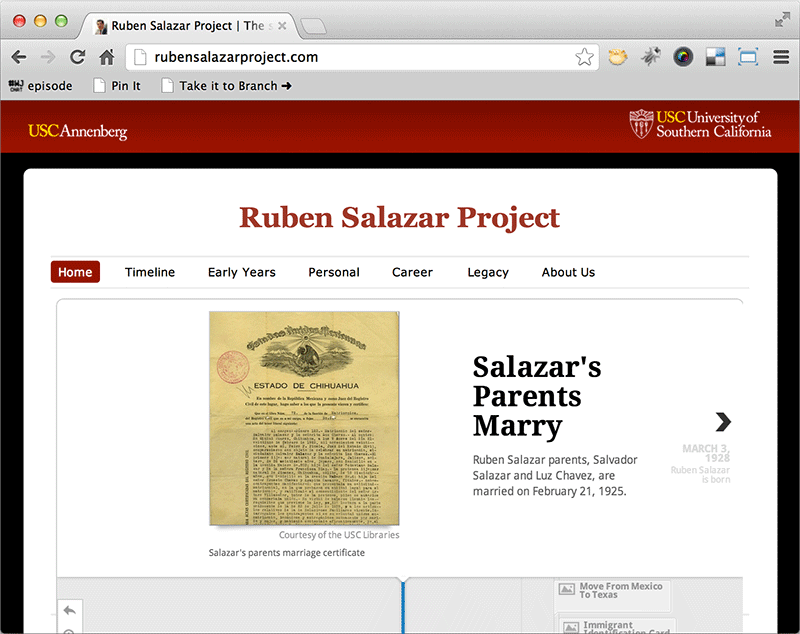
After a lot of work by the university, journalism school, faculty, but, most importantly, students, I am proud to announce the launch of the Ruben Salazar Archive site: http://www.rubensalazarproject.com

As part of an experimental directed research course, led by Félix Gutiérrez and myself, nine students had access to the legendary Los Angeles reporter’s personal archive, which was donated by his family to the university.

These students were among the first at the university to review the items, most was which were unknown to us, as part of the class to try to tell the private story of a public figure.

As the students indexed and digitized the content of these boxes, each one of them identified a story to tell to help bring this historical figure’s past come to life.

The work resulted in this rich site, which includes an interactive timeline (it looks amazing on a tablet).

The students were:
Elaine Baran, Melissa Caskey, Juan Espinoza, Regina Graham, Gustavo Gutierrez, Grace Jang, Elena Kadvany, Bianca Ojeda and Frances Vega

Learn more about the project here.

Categories: Academia, Diversity, Journalism, NAHJ Tags:
29 Sep

Ode to the printing press operator (and many others)

This thought just occurred to me… so let’s see if I can express it here.
Our industry has experienced many, MANY changes. Obviously.

But one the things I think we tend to forget are the people outside of the newsroom and even the business side.

When was the last time you thought about the printing press operator? The one actually printing the beautiful broadsheet that millions still read. (Yes, millions.)

The people who know how to make the presses sing, carefully printing news and information efficiently… and under their own deadlines.

Those that love — or deal with — the loud roaring sound of the presses.

Those ones that truly get their hands dirty with newsprint.

The real ones who can actually “stop the presses.”

You know, they could be working somewhere else. They, too, know they could get another job where their industry isn’t “dying.”

But they choose to work the presses.

Why?

I bet they feel the same amount of pride working their craft as you feel in yours.

I bet they value their role — albeit one often forgotten, evolving but yet still vital — in helping inform their community.

I bet they are as proud to work for the masthead as the journalists across town.

I bet their chests get broader when they see a powerful headline that will help their community as it blurs fast through the presses… I imagine that they try to print it even faster to get the information to the community quicker. (But without compromising quality.)

They feel the same pain and have the same worries when they see the revenue challenges and face layoffs.

Let’s take this out of print and look toward audio engineers. Or how about those that run the backend equipment that makes the nightly newscast viewable via satellite.

Let’s look at the computers — granted old ones, typically stuck with IE — and the people behind making these crappy things last a little longer to help keep the budget lean.

The IT people that take pride in their work, knowing that they are facilitating the production of journalism. They can probably make more money elsewhere, but stay here because they want to help inform their community too.

How about the Web developer? Coder? Programmer?

They can make a ton of money elsewhere.

So can you… P.R. is right there. All companies are now media companies and they need help telling their own stories.

These are great, honorable jobs. But you, like the others, stay.

Look, we are all “suckers.”

Suckers because we believe in journalism, in informing our community, in doing the best we can with the resources we’ve got… on deadline. And we do it all while working long hours and being underpaid.

But we can’t imagine doing anything else.

These are all different crafts. All to be respected. All to be valued.

Just a thought.

// State of Play
The closing credits of the journalism thriller, State of Play, is all about the printing of the paper. It’s a great homeage to the process. I captured the final frames because I loved their CMYK moment that passes in a blink of an eye. Here it is slowed down,

Categories: Journalism, Personal Tags:
28 Sep

Nieman Lab piece on rebooting J-schools: Take control of your education

Comments off

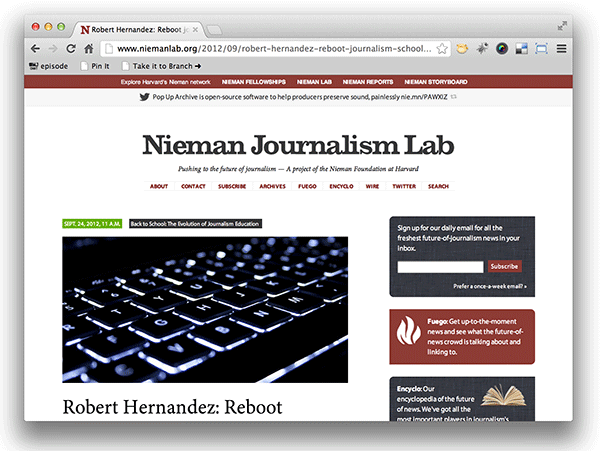
I was invited by Nieman Lab to write a piece on rebooting J-schools. My take was bypassing the “debate” and empowering the students directly. Tell me what you think: Robert Hernandez: Reboot journalism school? Take control of your education instead

If and when I have time, I hope to Storify the reactions and add it to this post.

My favorite, though, came from Justin Ellis, who was the person that invited me to write the piece:

15 Sep

Google it

Comments off

via imagur

Categories: Journalism Tags: ,
10 Sep

Why I’m running for the ONA Board again

Comments off

ONA logo
There’s more work to be done.

A lot more.

Simply put, that’s why I am running for re-election to stay on the Online News Association‘s Board of Directors.

As I said when I first ran, I believe ONA needs to be the center organization leading and guiding our industry forward. That goal and need is as strong as ever.

A core part of my work — from teaching/training to #wjchat to Learn Code for Journalism to Tech & Tools to Horizontal Loyalty — is in sync with the organization’s mission: empower journalists to move our industry forward.

I’m proud of the work we have done in the last two years with the board. The organization has added more training, offered more scholarships, expanded its programs and has taken important steps to solidify itself as an essential part shaping the future of journalism.

But please don’t think it’s easy.

It takes a lot of work and I am fortunate to work along side with incredibly smart and passionate board members and staffers that give it their all. You have no idea. (If you see them at ONA12, please thank them for their work. Hell, buy them a drink!)

I feel that I contribute to the organization. I bring diversity — culture, age, ethnicity, location and experience — to the group. I bring my Web/tech background and experience to the organization. And I… how do I put this? I’m that guy … that one who asks tough questions to keep us honest and hold us accountable. Some of you saw that with the Patch thing. It was not a fluke. Ask my peers, they see it in our board meetings.

We face other challenges too.

As an organization, we need to find scalable ways that tap into the diversity of our members’ skills/experiences to share them and help them grow.

Web journalism is a broad term. Because we are inclusive, it’s an incredible strength for ONA. But if we don’t take advantage of it correctly, we look unfocused and diluted.

I think ONA needs to be the place that brings the diversity of Web journalism together to grow stronger together… and I’d like to continue to be at the table to make this happen.

Please help shape the future of this organization and journalism by voting.

And, if you think me worthy, please consider voting for me. I’d truly appreciate it.

Thank you,

Robert
Read my bio here

08 Sep

My work featured in CJR – twice!

Comments off

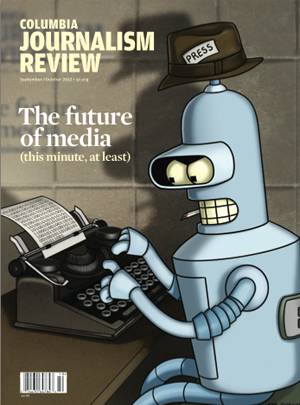
Columbia Journalism Review logoI’m really proud to share that two of my projects were featured in the Columbia Journalism Review – in both print and online.

While you can read the article online, I strongly recommend you check out the latest issue of the print magazine, which focuses on The Future of Media (this minute, at least).

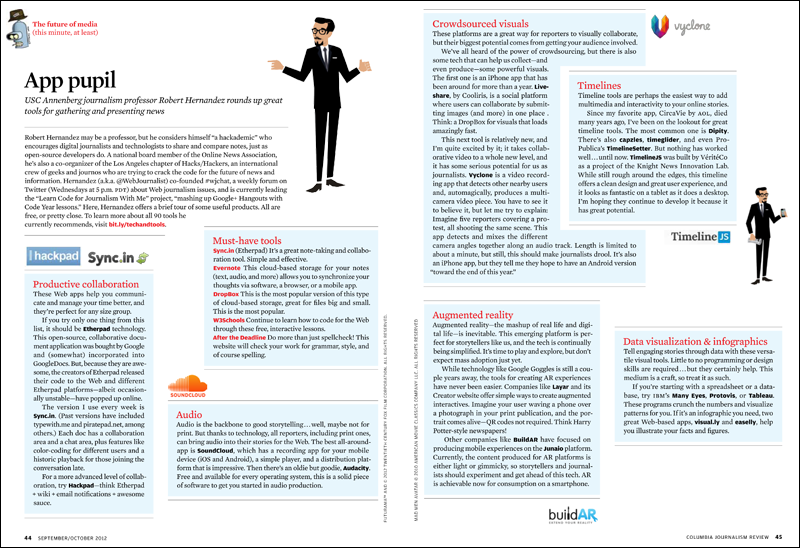
In it you’ll find a two-page spread about my Tech & Tools project, where a Mad Men version of myself showcases some of my favorite apps. Below is a screenshot of an early proof, but go get the magazine!

Coincidentally, a few days later, CJR also decided to write a piece for its site exploring Twitter chats: Building a community 140 characters at a time.

While others are mentioned, #wjchat was prominently featured. For those that may not know, Twitter chats are virtual meetups held around a hashtag to discuss a topic. #wjchat is on Web Journalism and is a chat I created with four others in February 2012.

It’s crazy to think that this weekly miracle has been happening for two-and-a-half years!

28 Aug

CU-Boulder Hearst Professional-in-Residence

I usually don’t write about things like this, but, I have to admit, this one is pretty cool.

I’m proud to announce that I have been selected to be University of Colorado‘s Hearst Professional-in-Residence.

From their invitation letter:
“The Hearst program is made possible by an endowment from the Hearst Foundation, and its purpose is to introduce nationally known, accomplished journalists to our students to enrich their journalism studies. With your work both as a teacher and as a practitioner in digital news and social media, we can think of few people better qualified to play this role.”

As many in the academic community know, the Journalism school has gone through some serious challenges. They still have a journalism program and, like most programs, are re-building.

I’m honored that they’ve asked me to join them in the conversation.

I’ll be there September 27 and 28.

17 Aug

My response to The Hartford Courant’s “Spanish-language strategy” with Google Translate


Como una cortesía para The Courant, por demostrando ignorancia y falta de respeto a su propia comunidad, déjeme decir: lo cagaron.


If you were to translate this using Google Translate, guess what… it would be wrong. Anyone who is bilingual wouldn’t be surprised. But they would be surprised in hearing that a news organization would solely depend on using this primitive service as their “Spanish-language strategy.”

Sadly, this isn’t a joke: Hartford Courant’s Spanish site is Google Translate by Poynter

But, instead of just being disgusted or insulted by The Courant’s “strategy,” let me offer some tips for an actual strategy:

1. Hire a diverse staff, and in this case, a Spanish speaker. Listen to them. Anyone in their right mind would have told you this was a bad idea.

2. I know resources are tight, as an affordable alternative to hiring more staff, partner up with the local Spanish-language news organizations. Believe me, they are there. And they’d love to help you inform the community. (Hey Courant, have to tried working with Connecticut’s Latino News Source: ctlatinonews.com?)

3. No Spanish-language news organization in your town? Look again. Think radio, newsletters or neighboring towns. Any of these will be better than an automated site.

4. Still confused? Reach out to the National Association of Hispanic Journalists to find local members in your area, including Spanish-language news organizations.

5. But, let’s say there are no Spanish-language news outlets. Partner up with the largest, Spanish-language local business. They know their community and are fully aware of the information network that is functioning now.

Lastly, apologize to the fastest growing demographic in your community for treating them with such little respect. It’s not a smart business move to belittle them, especially if you want to tap into their growing influence.

I preach experimentation, risk taking and embracing failure. You experimented and took a risk… and you failed. Oh, did you fail.

Learn from your big mistake and start genuinely engaging with your own diverse community.

Do you have any tips for The Courant or any other news organization trying to serve its Latino community? Please share them in the comments.


Oh, and if you are wondering, here’s how I’d translate my statement:

As a courtesy to The Courant, for displaying its ignorance and lack of respect to its own community, let me say: you fucked up.

16 Aug

What does Google’s autocomplete say about the 2012 U.S. presidential election?

Comments off


As we know, Google’s mission “is to organize the world’s information” and one of the most influencial ways they help their users is through their suggestions via their autocomplete feature.

Autocomplete suggestions occur when you begin typing out a search. According to Google, it’s “algorithm predicts and displays search queries based on other users’ search activities and the contents of web pages indexed by Google.”

So, I was curious. What are Google users routinely searching for when it comes to the candidates for president and vice president?

Here are screen grabs displaying the current suggestions:

Google autocomplete results for Barack Obama


Google autocomplete results for  Mitt Romney


Google autocomplete results for Joe Biden


Google autocomplete results for Paul Ryan

Search details: These searches were done on August 16, 2012 at around 2:30PM PT. I used a “reset” Safari browser. I reset the browser before each search. I was not logged into Google. I did these searches from my office USC campus, in Los Angeles.

Guessing from the results, these suggestions change over time, reflecting the larger news of the moment.