Archive

Archive for the ‘Rant’ Category
23 Dec

Introducing Forbes to Media Diversity

You can see more diverse journalists of color — of all ages — in this spreadsheet: http://diversify.journalismwith.me/. You can read about how this came about here: Crowdsourcing ‘web journalism rockstars of color’

18 Jul

Meme and me: Barack, Hillary and the Women’s World Cup Finals

So, there really is no need to write this… but in the back of my head… there’s a tinge of worry.

Today, after reading some comments on Google+ about expecting the Internet to merge this historic photo of the deadly Osama mission and this just-released photo of the first family watching the Women’s World Cup Finals, I couldn’t help myself and mashed together within 10 minutes.

No harm was done… it’s just another obvious Internet meme. But I thought… perhaps over thought… what if some jackass attacks me and says this threatens my journalistic credibility. What if they say that if I “fabricated” this, could I have lied elsewhere?

It’s unreasonable, no? Actually… not really.

It seems like people are often looking for ways to undermine someone’s credibility. Taking quotes out of context, re-editing video, or Photoshoping an image is not uncommon.

But there is a significant difference.

One is to lie and the other… is just Internet humor. Perhaps no different from adding a poorly written caption atop a cute cat photo.

But still… while I shared it on Google+ — and fully knowing that by posting it online it would be shared – it felt weird to see someone share it. I got worried.

What if…

In journalism, it takes years and years of hard work to build up your credibility… and sometimes one mistake to wipe it all away.

That’s the time we live in at the moment. Not just for journalists, but newsmakers and civilians as well.

Maybe that’s why I am writing this… an attempt to say THIS WAS AN INTERNET JOKE, NOT JOURNALISM.

And that’s cool, right? RIGHT?

Tell me it’s cool and that I’m over thinking this.

P.S. The Internet gets it… someone just added Sad Keanu to the photo!

27 Jun

What if we are part of the voiceless community?

NOTE: Republished on Online Journalism Review: http://www.ojr.org/ojr/people/webjournalist/201106/1987/

I hate hypocrites… especially when they’re journalists.

I’ve been a bit disappointed with how some journalists have been writing about Jose Antonio Vargas‘ recent announcement that he is an undocumented immigrant. Many are questioning Vargas’ journalistic credibility because he had to hide his immigration status.

Jose Antonio VargasAs if journalists – including columnists and editors – have never lied before or broken any laws. (Just think about your college years.)

Like the communities we cover, newsrooms are filled with sinners and saints… perfectly flawed human beings.

But lies have different degrees, don’t they?

It wasn’t long ago that people had to hide, or lie about, being gay. They had to conceal a part of their true identities to avoid discrimination or to get a job, including one as a reporter.

While they felt forced to hide a part of themselves, something tells me they still made strong journalists and did not lie in their reporting.

If I recall correctly, when the gay marriage issue erupted in San Francisco, The Chronicle pulled a gay photographer off the story because editors assumed a conflict of interest. What Chronicle editors failed to note is that straight people also have opinions about gay marriage that may also pose a conflict of interest.

The bottom line is, as far as I know, Vargas never lied in his stories. And just because he had to hide about being part of a certain community, it doesn’t automatically nullify his journalistic credibility or achievements.

Being a part of a community does not disqualify him as a journalist.

Just like Diane Sawyer, for example, isn’t disqualified as a journalist because she worked in Republican Party politics before, during and after President Nixon’s administration and subsequent resignation. Same as George Stephanopoulos isn’t disqualified after working for President Clinton’s administration.

They are just two of many examples.

What has bothered me the most, really, is how journalists are treating Vargas as “other” … as if his reality is not a common one. As if undocumented immigrants, or illegal aliens or whatever label you use, aren’t part of our communities.

We are all made up of different communities, and these often are the same communities we attempt to cover through our journalism. Some communities we praise, others we tolerate and others go unacknowledged.

I, like many others, believe that a diverse newsroom – comprised of different communities – makes for stronger, more relevant journalism. But the sad reality is that not all communities are seen as equal – or as newsworthy.

Our job is to give voice to the voiceless… but what happens if we are part of the voiceless community?

That’s the position Vargas found himself in. And he, like others from different communities before him, decided to come out and remind people the “other” is really a part of “us.”

About a year ago, I actually wrote a post about this topic, but under advisement from my closest editor I deleted it.

The post was inspired by Harvey Milk‘s powerful message: “You must come out” to give a real face to a community that is under attack. This was around the time of Arizona’s SB1070 bill.

My editor thought my post could be taken out of context and hurt my career.

I don’t know how these words will be taken… and quite frankly, I’ve debated whether or not I should ever publish them… but I hope my editor is not right.

In light of Vargas’ story – one that took more courage to share than my story – I feel that I am obligated to share my experience.

Allow me, however, to frame the reason why I am sharing my story now:

  • I’m not asking for any political action. (Don’t call me an activist.)
  • I’m not trying to ride Vargas’ coattails. (Don’t call me a poser.)

I’m writing this because as journalists we can’t afford to forget that we are part of the “other” … that good journalism is truly inclusive.

I, like everyone else, am part of multiple communities: I am a father, a husband, a renter (former homeowner), college graduate, an educator, a Roman Catholic (but I often disagree with the church) and the son of immigrants from El Salvador.

While my mother entered the country by plane with the right papers, my father entered by crossing the border illegally in the 70s.

He quickly became a U.S. citizen.

But let’s be honest here, the act of an immigrant crossing the border without the right papers in pursuit of a better life often overshadows their accomplishments as legal citizens.

To clarify, I was born a U.S. citizen. But all my success as a person and as a journalist, I owe to my immigrant parents.

My father, like millions of other immigrants, reflects the story of America – whether we want to admit it or not. Coming to this land (by any means necessary) with nothing, working [expletive] hard and making a better life for himself and his family.

For the record, my father graduated at the top of his high school class in El Salvador, which earned him a scholarship to Germany. He worked there, but giving into the request from my mother’s family, he moved to the United States after marrying her.

My father ran several small businesses and was a homeowner for more than 40 years. He lost them in the bad economy, but had relaunched his auto repair shop early last year. He passed away in November and the outpouring of support from the local community was a true testament to his accomplishments. That man helped so many people… I had no idea.

My mother struggled and worked hard in her own immigrant story. She made a small living by cleaning houses and other service jobs, including working at the food court of Cal State University, Northridge. She joined my father as an entrepreneur until they separated.

I can tell you more about their story, but let me just say this: “Their” story is part of “my” story. And “my story” is part of “our” community. And all of that is part of journalism. To shun someone, even a journalist, for owning their story, their community, is bad journalism.

If you invalidate Vargas as a journalist for being an illegal immigrant, you are a journalist in denial thinking that he is not part of your community (the one you are trying to cover).

Again I ask: Our job is to give voice to the voiceless… but what if we are part of the voiceless community?

If you are part of a community that is being attacked or politicized, as a journalist it takes courage to step forward and speak up, not as an activist… but as someone who wants facts to prevail. Not talking points.

I applaud Vargas for his courage. He’s a reminder that the “other” is really within “us.”

10 Feb

Mubarak ‘stepping down’: Dissecting a media echo chamber

NOTE: Republished on Online Journalism Review: http://www.ojr.org/ojr/people/webjournalist/201102/1942/

Here is an attempt to break down the timeline of today’s news from my point of view. Please note that this mainly reflects Twitter and my experiences. I’ve used Twitter’s advanced search, which isn’t great, and gotten some crowdsoucing help. Please feel free to contact me to make this more accurate.

P.S. This is my first Storify … be gentle.

06 Dec

Debate over journalism required skills gets heated

NOTE: Originally ran on Online Journalism Review: http://www.ojr.org/ojr/people/webjournalist/201012/1915/

Thanksgiving is traditionally the time distant family members come together over a delicious meal… and, well, fight. Last week a fight (okay, more like a heated debate) broke out over what skills a modern day journalist needs to have.

It began with a post from Mark S. Luckie, The Washington Post‘s National Innovations Editor, founder of 10000words.net and author of The Digital Journalist’s Handbook.

His 5 Myths about digital journalism sparked a flurry of reactions, most notably from Andy Boyle, digital developer with The New York Times Regional Media Group, Anthony DeBarros, senior database editor at USA TODAY and Aron Pilhofer, editor of Interactive News at The New York Times and co-founder of DocumentCloud.org.

If you don’t know these names, you should. They are some of the most innovative minds in the industry … and I happen to respectfully disagree with all of them.

Well, sort of.

To be honest, I think there is more of a misunderstanding rather than a disagreement here.

Before I go on, let’s address a question that may have popped into someone’s mind: Who the hell am I to weigh in on this debate?

I’ve been a Web journalist for more than a decade and, prior to coming to USC Annenberg, I was the director of development for seattletimes.com where I led a team of engineers and designers. We developed and innovated projects for the site ranging from a taxonomy to geolocation to a custom commenting system to hijacking/hacking the print publishing system to data-driven special projects.

So, allow me to set up the framework from my point of view.

The skills that make up a successful, modern newsroom are as diverse as the communities it tries to cover and serve.

There are some traditional, fundamental skills that are still the unifying foundation, but there is also a new (really, not that new but not yet standard) set of skills each journo needs to have.

And let’s just say it: because our industry has been evolving/changing/etc., there are a lot of unknowns (and fears) about what that set of skills is to be a successful, modern journo.

Of course there is no shortage of opinions, including my own, trying to address those unknowns. But also among them are, well, some opinions spreading hype and bad information.

To be clear, the guys I mentioned above are not the problem.

Not even close.

Who I am referring to (and who I believe Mark was too) are the folks that are telling reporters – all reporters – that they need to stop the craft of writing an engaging story and replace it with the craft of writing innovative code.

They have also said things like photography is dead and copyediting is expendable, but that’s for another post… let’s focus on programming.

Their message essentially is if you don’t master programming skills to create an app or database, you don’t have a future in journalism.

And again, to be clear, the guys I mentioned above do not agree with that statement, at least based on what I’ve seen of their writings and work.

But that hype and bad information I described does exist. It has for years.

I can’t tell you how many times a panicked mid-career journalist or an aspiring student has freaked out asking me for advice on whether or not they need to be a developer/programmer or database engineer or Flash developer (three different jobs that share some similarities).

So cut to the chase Hernandez… what’s your take on the required skills to be a journalist today?

I do not believe you need to master programming to succeed in journalism.

I do believe you need to respect and understand the power of each and every craft, not just programming, but photography, design, texts, etc. that make up journalism. They are not as simple as hitting a button.

I also believe, at the most minimum, EVERY JOURNALIST (whether be it reporter, editor, photographer, etc.) of EVERY BEAT needs to be proactive in spotting opportunities to best use the diverse crafts.

I believe that, in terms of the data-journalism, EVERY REPORTER needs to know the basics of Excel and be able to function inside a database to find the story. But they do not need to build one from scratch.

But the reality is, depending on the size of your shop, you may be required to wear multiple hats that can touch on programming, photography, social media, etc. The good news is that there are tools and communities out there to help you.

NOTE TO PUBLISHER/EDITOR: Please realize that you need engineers/developers in your shop. You probably need twice as many as you current have. Don’t take this post as buzz or get it twisted thinking you shouldn’t hire more. You should. And you should also invest in training your newsroom in a variety of skills ranging from programming to photography to social media.

I agree with DeBarros and do not believe programming replaces the story. Never has, never will. When was the last time you had a driveway moment with a database?

But when was the last time you were able to understand the weight of 251,287 cable dispatches without a database?

Those are made possible because of different, yet equally important, skills. And thankfully, regardless of your answer, we don’t have to choose.

We need these diverse set of skills, of every level, populating our newsrooms. We need them to influence each other. We need them to work together. We need them… to survive and evolve.

We also need to acknowledge that not everyone will be able to do these skills. Some will be better than others. But, guess what, that’s okay.

Because if we are to attempt to serve our communities that are consuming and expecting our news and information in a variety of ways, we need a newsroom full of diverse people bring different experiences, skills, perspectives and ideas to the table.

We can’t afford to get distracted by feuding over something like this. We’ve got too much work to do.

30 Oct

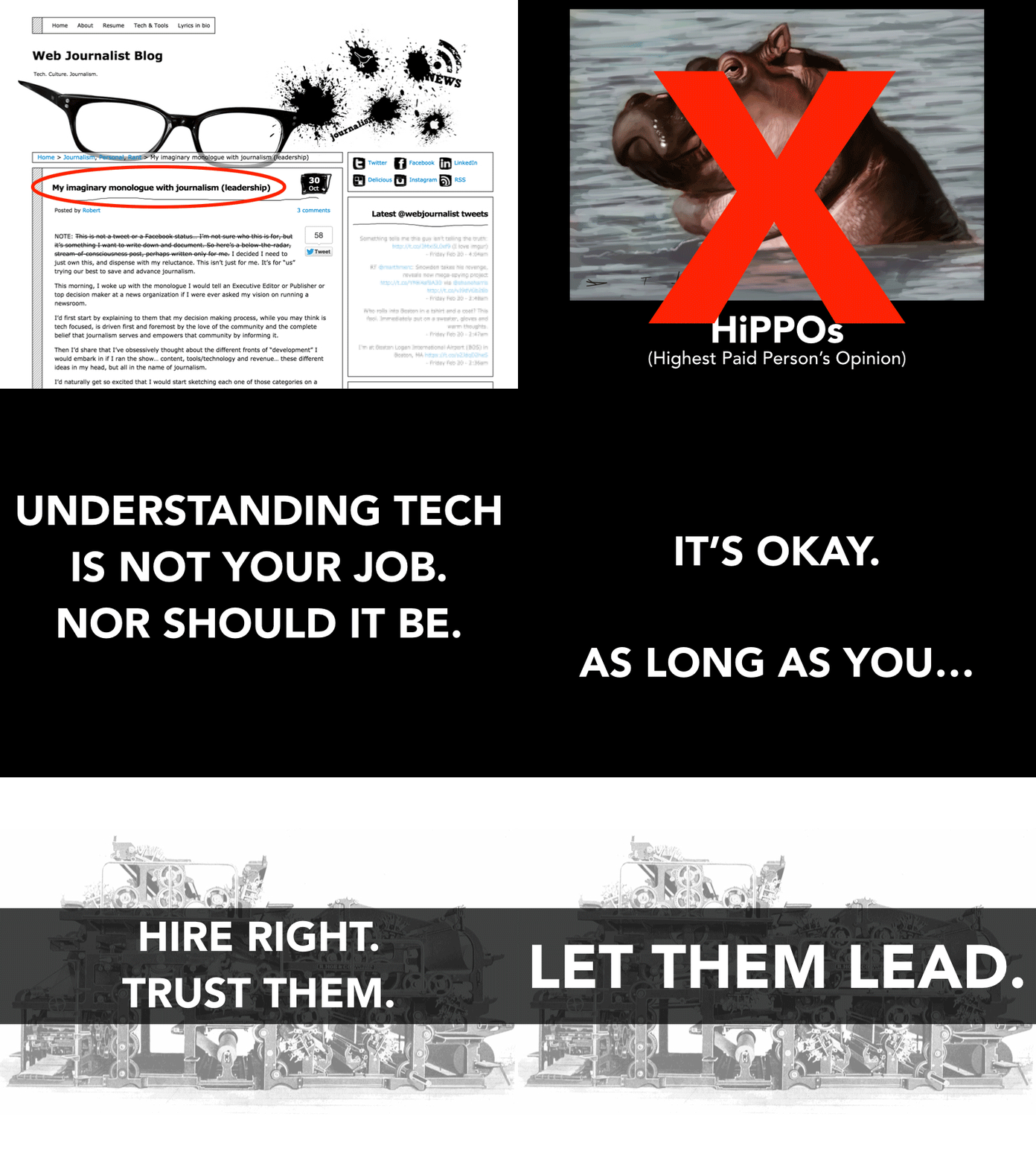
My imaginary monologue with journalism (leadership)

NOTE: This is not a tweet or a Facebook status… I’m not sure who this is for, but it’s something I want to write down and document. So here’s a below-the-radar, stream-of-consciousness post, perhaps written only for me. I decided I need to just own this, and dispense with my reluctance. This isn’t just for me. It’s for “us” trying our best to save and advance journalism.

This morning, I woke up with the monologue I would tell an Executive Editor or Publisher or top decision maker at a news organization if I were ever asked my vision on running a newsroom.

I’d first start by explaining to them that my decision making process, while you may think is tech focused, is driven first and foremost by the love of the community and the complete belief that journalism serves and empowers that community by informing it.

Then I’d share that I’ve obsessively thought about the different fronts of “development” I would embark in if I ran the show… content, tools/technology and revenue… these different ideas in my head, but all in the name of journalism.

I’d naturally get so excited that I would start sketching each one of those categories on a napkin, trying to explain to the person what is in my head.

But then I’d stop… perhaps mid-sentence… put my pen down… look the person in the eye and say:

Look, the biggest obstacle in journalism right now isn’t whether people trust “us” or not. It’s not even the revenue crisis we are all facing and feeling every day.

The biggest obstacle is… you.

[Awkward pause]

Then, if the person hasn’t left the table, I’d say:

I can continue trying to explain these concepts to you, draw my little pictures, employ my weird (often pop-culture drenched) analogies… all to get you closer to understanding these concepts.

Or, you can just admit (and hopefully be okay with) the very strong possibility that you may never really understand.

But, also, realize that it’s not about you… it’s not about you understanding.

That spending time on trying to have you understand, so you can approve, has delayed and hurt us for SO MANY YEARS. We can’t afford that time any more.

Please know that you have a very important role here, but trying to be the visionary when you don’t understand is not that role.

Take that leap of faith by putting your trust in the people who are just as passionate, concerned, obsessed about journalism as you are… trust those “Web people.”

You see, I’d say, that for each category I described, there are amazing Web journalists doing work that is changing our industry, but leadership hasn’t noticed, let alone appreciated it.

In fact, these amazing people are on your staff right now. But, because you don’t understand or approve it, you don’t see it.

These people are getting heart-broken by the missed opportunities and your bad decisions. Don’t buy that vendor’s product, especially if it is a CMS! Stop getting obsessed with the buzzwords you hear at conferences! Stop listening to those hype machine, journo pundits offering bad advice!

Stop it.

Because if you don’t, all I’m doing is drawing on a napkin… is writing a Jerry Maguire style blog post… all we’re doing is just talking. Spending time and energy on you and not on the community.

Stop it. And take that leap… with us.

Categories: Journalism, Personal, Rant Tags:
13 Sep

Online Journalism or Journalism Online? There is a difference

NOTE: Originally ran on Online Journalism Review: http://www.ojr.org/ojr/people/webjournalist/201009/1885/

I’m a journalist, first and foremost.

It doesn’t matter the medium — pixels or paper, airwaves or WiFi — I want to produce it, distribute it, consume it and innovate it. Oh yeah, and I want to save it.

But the term “journalist” is a broad category that is only increasing in size, filled with diverse specialties and talents.

So, if I may, I’d like to be more specific: I’m a Web journalist.

No doubt you’ve heard of this term before, but recently I’ve notice a misinterpretation of the term.

Please allow me to clarify it.

When I first started my Web journalism career, a good friend and mentor pulled me aside and planted a concept that still guides me today: It’s not Journalism Online, it’s Online Journalism.

There’s a lot of difference between the two, besides rearranging the words. To me it is simple and powerful.

Think of it this way: Art Online or Online Art.

Take a photo of Mona Lisa, one of the most famous works of art in the history of mankind. Get a nice, hi-res image of the painting and post it onto the Web.

The single image on the Internet brings this classical piece of art to millions of people who never will travel to Paris to see it first-hand.

That is Art Online.

Now, think of art that takes advantage of, or is based on, technology and the Internet. It’s a type of art that can only exist because of the Web and the latest technology.

To do this, the artist has to be creative in both the artistic and the technical space. The artist must harness technology to captivate its intended viewer, listener‚ user.

Instead of describing it, take a quick trip and experience some Online Art here… but come back, please. Check out Jodi.org (I recommend these two pieces) or Seoul-based Young-Hae Chang Heavy Industries (Here are two examples) or explore the collection at Turbulence.org (like this one).

On The Media did a profile on an art piece that merges the digital realm with real life. A simple device with a powerful title: “A Tool to Deceive and Slaughter.”

This art piece could not exist without the Internet. Without eBay, of all things. It’s art that evolves and even generates revenue for its artist.

So, back to clarifying the journalism terms.

Journalism Online is what we use to lovingly call “shovelware,” which is taking existing “legacy” content and posting it on the Web. We know that there is immeasurable value in having the paper’s articles, radio show’s podcast and TV show’s newscasts available on the Web.

Text alone is perhaps the most powerful form of journalism on the Web.

But that is still Journalism Online.

What I do…. what I identify with… what I live and breathe is Online Journalism.

So, what is that exactly?

Well, it’s hard to explain but I look at the latest technology and opportunities only available on the Internet and try to harness them for the advancement and distribution of storytelling and journalism.

I look at FourSquare and see how we can use that to find eye-witness sources in breaking news events. I look at photo gallery widget by TripAdvisor, meant for vacation snapshots, and see how it could enrich our coverage of, say, the World Cup.

I work with engineers and see how our crafts can work together and create new experiences. Like when we took RSS feeds from around the globe and mapped them for a Seattle Times project. It was based on the addicting, but somewhat pointless Twittervision.

Think of how more powerful our journalism becomes when we crowd-source. Add some technology, like CNN did by using Microsoft’s PhotoSynth, and it captures a historic moment in a unique way.

Don’t get me started on augmented reality.

What can I say? I am a geek. A technophile. An iPhone addict.

But I’m a journalist first.

News judgment and ethics are core. Fear of and respect for deadlines drives me. The sick sense of humor we use to cope with traumatic news events is my warm blanket.

The newsroom is my home.

I’m just a mad scientist taking the latest tech to help advance the Fourth Estate.

I’m a Web journalist.

Well, at least until the new technology replaces the Web.

09 Jun

Eight reasons why I hate list stories

< rant >
Is anyone else getting tired of these posts and stories that list X amount of reasons or tips for something? 134 ways to be innovative. 12 ways to keep your job. Four ways to save journalism. Weren’t these once limited to dietary tips?

Look, it’s a good narrative device, but it’s feeling a little played out… over used. Like the an 80s video.


Ideally, you found this post through the Tweet I sent out and the video above makes sense… a little sense?

If the answer is no, it could only mean two things: This is a lame post or you need to read about Rickrolling.

NOTE: I reserve the right to totally be hipacritical and do a list-related posted in the future… in fact, I’ve had one in draft for some time. Multimedia’s Ten Commandments. Does that count?

< / rant>

Categories: Rant Tags: